
Last Updated: September 27, 2026
Mining operations worldwide face a critical inflection point. To modernize legacy mining infrastructure, equipment deployed 15-20 years ago must be redesigned for the data-intensive, connected operations that define modern extraction.
Modernizing legacy mining infrastructure is now essential for competitiveness. Underground and open-pit mines generate enormous volumes of operational data, equipment diagnostics, environmental conditions, ore grade readings, and safety alerts, that legacy systems can’t reliably capture or analyze, resulting in safety blind spots, inefficient extraction, and costly equipment failures.
The challenge is structural: most mines operate fragmented systems never designed to communicate. Integrating new sensors, wireless networks, and analytics requires careful planning and phased deployment. Many directors hesitate due to concerns about production disruption or cost overruns.
Yet operational gains are undeniable: faster decision-making, reduced downtime, and better safety outcomes. The question is how to modernize without disrupting production.
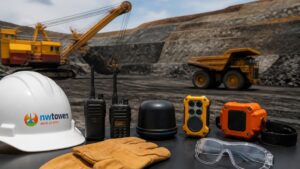
Mining environments are hostile: underground shafts block radio signals, open-pit operations expose equipment to extreme temperatures, dust, vibration, and electromagnetic interference. Standard enterprise equipment fails within weeks.
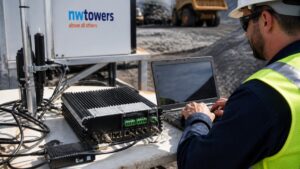
Industrial wireless connectivity for mining requires purpose-built hardware engineered for these conditions: maintaining signal integrity through rock, handling temperature swings from -20°F to 130°F, and surviving constant vibration.
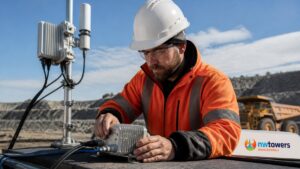
Northwest Towers designs antennas and wireless platforms specifically for mining operations, with IP-rated enclosures, sealed connectors, and materials for extreme temperature stability. Mining-grade equipment is the difference between a network that works and one that fails at the worst moment.
Real-time visibility is the primary value of modernizing legacy mining infrastructure. Modern sensors stream continuous data on equipment health and operational metrics, transforming decision-making from reactive to predictive.
Data-driven frameworks enable teams to optimize extraction, predict maintenance, and identify hazards early. Conveyor vibration sensors flag bearing wear days before failure; real-time ore grade readings allow instant parameter adjustments.
Sensor networks must transmit reliably across kilometers through challenging terrain with minimal latency, a 10-second safety alert delay is unacceptable. Northwest Towers’ managed Network as a Service (NaaS) approach provides connectivity infrastructure and monitoring so your team focuses on mining.
Most mines operate fragmented systems with incompatible protocols. Integrating them requires protocol translation, data standardization, and security architecture, not just new cables.
Legacy system interoperability is underestimated. You can’t replace everything at once, production can’t stop. The old system must run while you build the new one alongside it, with seamless data flow and unified operator dashboards.
Phased migration roadmaps are critical. Rather than risky “rip and replace,” introduce infrastructure gradually, validating each phase. Phase 1 pilots a single section; Phase 2 expands; Phase 3 retires legacy systems as new infrastructure proves itself.
Before deploying new devices, clarify your current state and goals. This assessment phase determines success or costly distraction.
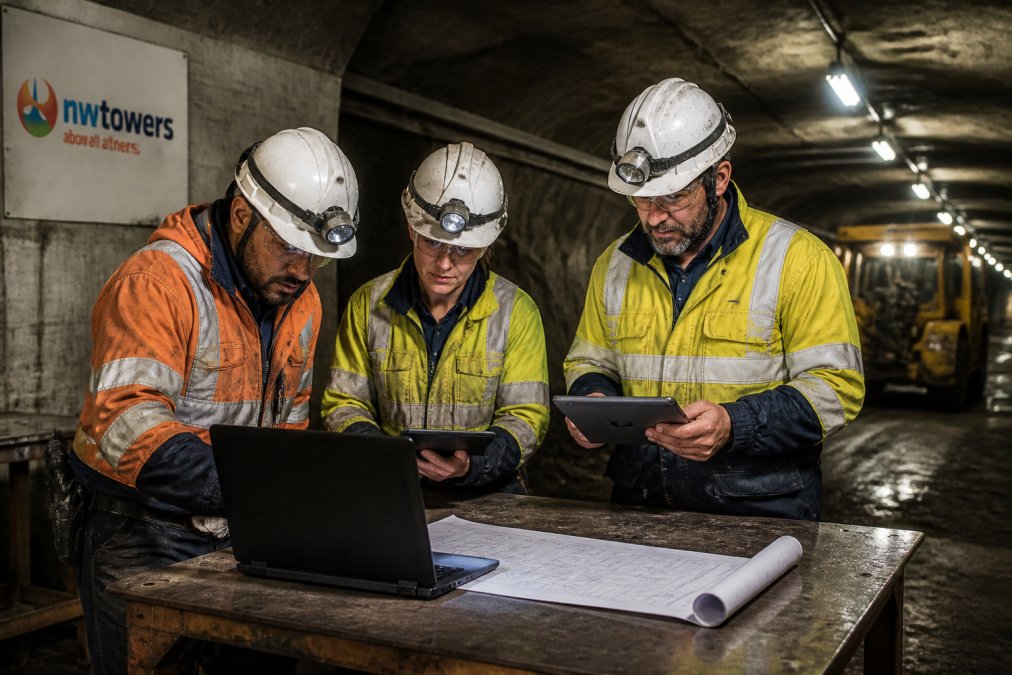
A digital maturity audit catalogs current systems, identifies data silos, and maps dependencies. It’s a practical inventory of what exists, works, is fragile, and blocks progress.
Document every networked system: control, safety, communications, monitoring. For each, record age, manufacturer, protocol, performance issues, and criticality. Identify which are connected and which isolated. Map data flows between systems.
The audit reveals regulatory compliance gaps. Your modernization must address safety and environmental requirements without creating vulnerabilities.
Mining operations must comply with regulations from the Mine Safety and Health Administration (MSHA), environmental agencies, and potentially state-specific rules. These regulations often mandate specific monitoring capabilities, data retention requirements, and incident response protocols.
Your modernization roadmap must account for these requirements explicitly. New wireless networks must support the safety monitoring systems MSHA requires. Data collection must maintain audit trails for compliance verification. Communication systems must provide redundancy to ensure critical safety alerts reach operators even if the primary network fails. Regulatory compliance isn’t something you add later, it shapes the architecture from the start.
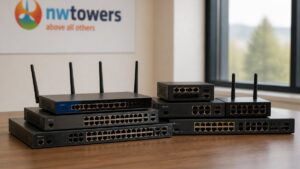
The hardware you deploy determines whether your network survives the mining environment or becomes an expensive failure. Consumer-grade or standard enterprise equipment will fail. You need purpose-built industrial wireless equipment.
IP ratings define protection against dust and moisture ingress. An IP67-rated device is dustproof and can survive temporary submersion. An IP68-rated device can be submerged indefinitely. For mining, IP67 is the practical minimum for above-ground equipment. Underground, where moisture from groundwater and humidity is constant, IP68 becomes necessary.
Temperature ratings matter equally. Equipment rated for 0°F to 104°F will fail in many mining environments. You need equipment rated for -40°F to 140°F or better. Thermal cycling, rapid temperature changes, causes expansion and contraction that eventually cracks solder joints and degrades components. Mining-grade equipment uses materials and assembly techniques that survive this stress.
Vibration resistance is often overlooked until equipment fails. Mining equipment experiences constant vibration from crushers, conveyors, and drilling. Standard equipment has components that fatigue and fail under sustained vibration. Industrial-grade equipment uses shock-absorbing mounts, potted electronics, and ruggedized connectors designed to survive this environment.
Modern mining operations deploy hundreds or thousands of sensors. Each sensor generates continuous streams of data about equipment condition, environmental factors, and operational metrics. These sensors must communicate reliably to a central system where data is aggregated, analyzed, and acted upon.
Sensor networks in mining face unique challenges. Underground, radio signals attenuate rapidly through rock. In open-pit operations, electromagnetic interference from processing equipment can disrupt communications. Sensor placement often means running cables through harsh terrain where physical damage is likely. Wireless connectivity solves the cable problem but requires careful network design to ensure coverage and reliability.
IoT integration means connecting these sensors to cloud-based analytics platforms where machine learning algorithms can identify patterns and predict failures. But this requires strong, secure connectivity with sufficient bandwidth. A sensor network that collects data locally but can’t transmit it reliably to analysis systems is worthless. Infrastructure revitalization in mining increasingly means deploying the wireless backbone that makes IoT actually functional. Establishing this robust wireless foundation often necessitates broader commercial infrastructure upgrades to ensure the power and stability required for continuous, high-capacity data transmission.
Attempting to modernize legacy mining infrastructure all at once is a recipe for disaster. Production stops. Operators lose visibility. Safety systems become unreliable. The solution is a phased approach that validates each step before expanding.
The first phase is deliberately small. Select a single section of the mine or a specific operation, perhaps a conveyor system, a ventilation zone, or a processing area. Deploy new wireless equipment, sensors, and monitoring systems in this limited scope. Run the new system in parallel with existing infrastructure so you can verify functionality without risking production.
This pilot phase surfaces real-world challenges that theoretical planning missed. You discover where signal coverage is inadequate. You identify unexpected electromagnetic interference. You learn how operators actually interact with new dashboards. You validate that the new system integrates properly with legacy equipment.
Most importantly, the pilot gives you concrete data on performance, costs, and timeline. You now know exactly how long deployment takes, what training operators need, and what support issues emerge. This data becomes the foundation for planning subsequent phases.
Once the pilot validates your approach, Phase 2 expands the deployment while addressing infrastructure gaps. This is where brownfield remediation often happens, cleaning up legacy pollution, removing obsolete equipment, and preparing sites for new infrastructure.
In mining, brownfield projects are common.
Phase 3 completes the deployment across the entire operation. Legacy systems are retired as confidence in new infrastructure grows. Operators gain the operational agility that modern systems enable, faster decision-making, predictive maintenance, and real-time optimization.
Modernizing legacy mining infrastructure means connecting operational technology (OT) systems to information technology (IT) networks. This convergence creates new security vulnerabilities that legacy systems never faced.
Modernizing mining infrastructure requires significant capital investment. Before committing, you need to understand the return on that investment and have a realistic picture of total costs.
Modernizing infrastructure means nothing if your workforce can’t operate it effectively. Workforce upskilling is often underestimated as a cost and timeline factor, but it’s critical to success.
The biggest obstacles include data silos from disconnected legacy systems, difficulty integrating new IoT sensors with aging operational technology, electromagnetic interference in processing plants that disrupts wireless signals, and the capital expenditure required for full replacement. Many operations also struggle with workforce readiness, staff trained on old systems need retraining. Phased migration approaches and managed services reduce disruption while maintaining operational continuity during the transition.
Real-time monitoring through sensor networks enables predictive maintenance, catching equipment failures before they cause downtime or accidents. Remote sensing and satellite-based mapping support better asset lifecycle management and environmental remediation tracking. Operational agility improves when teams access live data from underground and open-pit sites without physical presence. Automated extraction of data from distributed sensors eliminates manual reporting, reducing human error and response times in critical situations.
Yes. Modern rugged networking equipment is designed for interoperability with industry-standard platforms like Cisco. Rather than rip-and-replace, phased integration allows you to add new capacity and sensor networks alongside existing infrastructure. Many operations run hybrid environments where legacy systems coexist with new IoT-ready hardware. Northwest Towers specializes in system integration that bridges operational technology and IT, ensuring your investment in existing equipment remains productive while you modernize.
ROI varies by operation size and current state, but typical gains include reduced unplanned downtime through predictive maintenance, faster decision-making from real-time data access, and reduced capital expenditure through managed services models that eliminate large upfront hardware costs. Environmental compliance becomes easier with automated monitoring and satellite-based tracking. Calculate ROI by comparing current maintenance costs, downtime losses, and manual labor hours against projected savings from automation and system scalability.