Table of Contents
- Core Components of a Modern Mining System
- Mining Automation Technology: From Telemetry to Autonomous Haulage
- Industrial Wireless Connectivity for Mining: Keeping Remote Sites Online
- Mine Fleet Management Systems: Optimizing Load and Haul
- Open Pit vs Underground Operations: Two Different Connectivity Problems
- Cybersecurity and Interoperability Standards in Mining Infrastructure
- Implementation Roadmap for Legacy Mines
- Frequently Asked Questions
Last Updated: September 20, 2026
Core Components of a Modern Mining System
Mining systems are the integrated combination of hardware, software, and network infrastructure that connects equipment, sensors, and control rooms across an active extraction site. At Northwest Towers, we build the connectivity layer that holds those systems together in extreme environments. The most common mistake operators make is treating fleet software, process control, and wireless infrastructure as three separate purchases, they only deliver value when they share data.
Fleet Management and Dispatch Systems
Fleet management and dispatch software assigns trucks, shovels, and drills to tasks in real time, then adjusts as conditions change. A dispatch system is only as good as the telemetry feeding it: if a haul truck drops off the network for six minutes behind a pit wall, the optimizer routes on stale positions.
Distributed Control and Process Automation
Distributed control systems (DCS) manage the fixed plant: crushers, conveyors, mills, and processing circuits. Unlike mobile fleet assets, plant control runs on wired infrastructure with strict latency requirements. The two worlds meet at the network edge, where most integration projects stall.
Mining Automation Technology: From Telemetry to Autonomous Haulage
Mining automation technology spans a spectrum, from basic telemetry to fully autonomous haulage. Most sites sit somewhere in the middle, and that is fine. The progression matters less than whether each layer rests on reliable connectivity.
The practical stack looks like this:
- Telemetry: sensors report machine health, fuel, payload, and location. Data volumes are small and tolerant of latency, a fuel reading thirty seconds late is still useful.
- Remote monitoring: operators watch live dashboards and receive alerts. Latency starts to matter here, because an alert that arrives after the fault has cascaded is just a log entry.
- Process automation: fixed plant runs on programmed logic with minimal intervention. This layer is deterministic, control loops expect consistent timing, and jitter is a fault condition, not a nuisance.
- Autonomous haulage: trucks navigate, load, and dump without a driver. Here the network stops being a reporting channel and becomes part of the control loop itself.
Why each layer multiplies the one below it
The data growth is not linear. Telemetry might move a few kilobytes per asset per minute, while autonomous haulage pushes continuous video, lidar point clouds, and control traffic across the same network, often hundreds of times the volume, with hard latency bounds on the control portion.
Sites that pilot autonomous haulage on a network sized for telemetry alone typically see dropouts at the worst moment: during tight maneuvering near a shovel. Size the backbone for the automation you plan to run in three years, not the telemetry you run today.
The trade-offs nobody puts in the brochure
Automation is usually sold on labor and utilization, but the real trade-offs are operational:
- Determinism vs. flexibility. A fully automated circuit is efficient when conditions match its assumptions and brittle when they do not. Most sites keep a manual override for exactly this reason.
- Centralized vs. edge decision-making. Obstacle avoidance must happen on the vehicle, because a round trip to a control room is too slow; fleet-wide routing belongs centrally. Deciding which is which is an architecture question, not a software feature.
- Data volume vs. retention. Not every camera frame needs storing. Most practitioners keep high-fidelity data for a short window and aggregated metrics long term, because storage and review costs scale faster than the value of old video.
- Skills. Automation shifts the workforce from operators to maintainers and network technicians, a staffing plan, not just a technology purchase.
Industrial Wireless Connectivity for Mining: Keeping Remote Sites Online
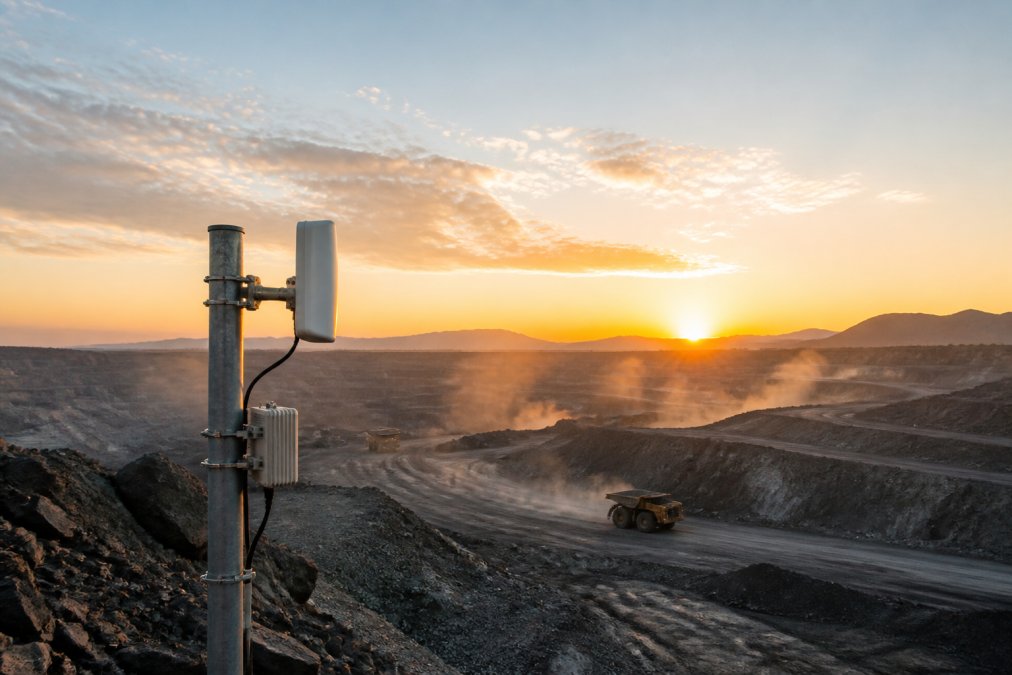
Industrial wireless connectivity for mining is the practice of building a network that survives dust, vibration, extreme temperatures, and constant physical movement. That combination is what separates a mine site network from an office deployment.
Mine Fleet Management Systems: Optimizing Load and Haul
Mine fleet management systems optimize the load and haul cycle by matching trucks to shovels, minimizing queue time, and keeping haul roads balanced. The logic behind these mining systems is well understood; the variable is data freshness.
Three levers drive most of the gain:
- Equipment use: keep every asset productive, not idle in a queue.
- Cycle time analysis: identify where minutes disappear between load and dump.
- Dispatch systems: reassign assets dynamically as conditions change.
Run cycle time analysis on segments, not averages. A site-wide average hides the two or three haul road segments where most of the lost minutes actually accumulate.
Open Pit vs Underground Operations: Two Different Connectivity Problems
Open pit and underground operations face opposite connectivity challenges. Open-pit mines need wide-area coverage across an expanding, moving footprint with clear line of sight. Underground mines need coverage that follows a tunnel network as it advances, with no line of sight at all.
| Factor | Open Pit | Underground |
|---|---|---|
| Coverage model | Wide area, mobile | In-tunnel, advancing |
| Primary obstacle | Distance and dust | Signal propagation and turns |
| Power source | Solar and site power | Wired backbone with wireless edges |
| Key risk | Coverage gaps behind high walls | Dead zones as headings advance |
Cybersecurity and Interoperability Standards in Mining Infrastructure
Cybersecurity in mining infrastructure is the discipline of protecting operational technology (OT) from the same threats that target enterprise IT, without breaking the real-time control production depends on. This is the area competitors address least, and where risk is growing fastest.
What a practical OT security posture looks like
Most practitioners find that a workable posture rests on four controls, applied in order:
- Network segmentation. Separate the control network (PLCs, DCS, autonomous haulage) from business IT with an industrial firewall or data diode. A common pattern is a demilitarized zone (DMZ) where only one-way or brokered data crosses.
- Asset inventory and authenticated access. You cannot secure devices you have not cataloged. Every radio, gateway, sensor, and controller should have a known owner, firmware version, and credential. Default passwords on industrial gear remain one of the most exploited weaknesses on connected sites.
- Monitoring and anomaly detection. OT traffic is highly repetitive by design, which makes deviations detectable, a controller suddenly talking to an unfamiliar address is a signal, not noise.
- Incident response that respects uptime. You cannot simply reboot a concentrator to clear an infection. Response plans must account for the fact that shutting down a mill is a production decision, not just an IT one.
Interoperability standards: the quiet cost of lock-in
Interoperability standards matter just as much as security, and they are why a mining system‘s total cost of ownership is often decided at procurement rather than deployment. Open interoperability means equipment from different vendors can exchange data without custom integration work; sites locked into a single proprietary stack pay for it later when they add a new drill fleet or third-party analytics platform.
In practice, the friction shows up in three places:
- Data models. Two vendors may both report “payload,” but define it differently, one as measured weight, one as estimated from bucket count. Reconciling those definitions is manual work that never appears in a sales quote.
- Protocols. Industrial protocols such as OPC UA and MQTT are common in plant and IIoT contexts, but vendor implementations vary in how completely they expose data. Ask which tags are actually published, not which protocols are “supported.”
- Time and location. A truck position is only useful if every system agrees on the timestamp and coordinate frame. Clock drift and mixed geodetic references are a frequent, invisible source of bad analytics.
At the procurement stage, ask each vendor for a written data dictionary and a sample export. If they cannot provide one, assume custom integration work is coming, and price it into the decision.
Where security and interoperability meet
These two concerns are not separate projects. A segmented OT network with authenticated devices is also the foundation that makes safe data sharing possible, you can expose production data to an analytics platform precisely because you control what crosses the boundary. Conversely, an open, well-documented interface is easier to monitor, because you know what normal traffic looks like.
A mining system’s value is capped by its weakest integration, and its risk is set by its most exposed one. Open interoperability and OT cybersecurity are not features you add at the end; they are constraints you design around from day one.
Implementation Roadmap for Legacy Mines
Legacy mines do not get to start from a clean sheet. The realistic path is phased, and it starts with an audit, not a purchase.
A workable sequence:
- Audit the existing network. Map coverage, identify dead zones, and document what each system depends on.
- Separate OT from IT traffic. Segment control traffic from business systems before adding anything new.
- Stabilize the backbone. Fix coverage and reliability on the load and haul circuit first, where the return is clearest.
- Add monitoring. Deploy remote monitoring and anomaly detection so problems surface before they stop production.
- Layer automation. Add process automation and, later, autonomous haulage on a network proven to carry it.
- Report and iterate. Feed production reporting and sustainability metrics from the same data layer.
Frequently Asked Questions
What are the core components of a modern mining system?
A modern mining system combines fleet management software, distributed control systems, and rugged wireless connectivity. Fleet management tracks vehicle location, fuel use, and cycle times. Control systems handle processing plant automation. Wireless networks tie them together, moving data from sensors and machines to a central operations center. Without reliable connectivity, even the best software cannot deliver real-time visibility into production or equipment health.
How does industrial wireless connectivity for mining improve system performance?
Wireless connectivity removes the need for miles of cable in remote or mobile operations. It enables real-time telemetry from drills, haul trucks, and conveyors, so dispatch systems can adjust routes and reduce idle time. It also supports remote monitoring of pump stations and ventilation fans. In open-pit mines, wireless backhaul links processing plants to pit operations. The result is faster data flow, fewer manual checks, and better equipment utilization.
What is the role of automation in current mining systems?
Automation handles repetitive, high-risk tasks. Autonomous haulage moves ore without a driver, reducing fatigue-related incidents. Automated drilling improves hole accuracy. Process automation adjusts crusher settings based on real-time ore size data. These systems rely on sensor fusion and low-latency networks. The goal is not full autonomy everywhere, but targeted automation where it improves safety and throughput. Operators still supervise and intervene when conditions change.
How does fleet management software integrate with a mining system?
Fleet management software pulls data from onboard sensors, GPS, and payload monitors. It feeds that data into dispatch algorithms that assign trucks to shovels and routes to crushers. Integration with the wider mining system means maintenance alerts trigger work orders automatically, and fuel data feeds into production reporting. For this to work, the wireless network must deliver consistent coverage across the pit and along haul roads, including areas with high vibration and dust.