
Last Updated: October 12, 2026
Industrial IoT connectivity is the practice of linking sensors, machines, PLCs, meters, and SCADA systems over a wireless network that keeps working in heat, dust, vibration, and extreme weather.
Most industrial IoT connectivity projects fail at the design stage, not the hardware stage.
A common mistake is treating an industrial wireless network design like an office Wi-Fi rollout. Industrial sites have moving equipment, metal structures, and long distances between assets.
Different sites need different wireless approaches. The right choice depends on distance, data volume, and how much the equipment moves.
Interoperability is the ability of different devices and systems to exchange data on the same network without custom workarounds. It matters because most industrial sites run a mix of old and new equipment.
Your design should let new sensors talk to existing control systems. That means checking protocol support before you buy anything.
We recommend mapping every device that must connect before finalizing a design. It takes a day of planning and saves months of rework.
Industrial wireless coverage planning is the process of mapping where signal actually reaches, then placing equipment to close the gaps. Good coverage planning starts with a site survey, not a product catalog.
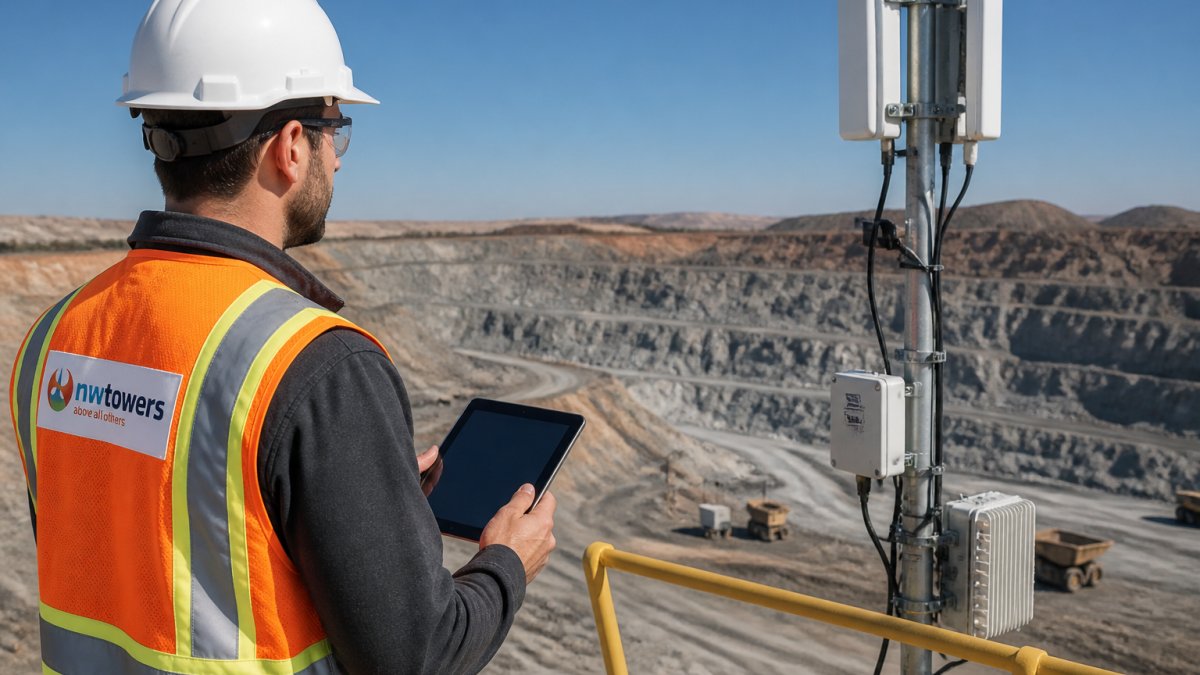
A site survey measures real signal strength across your site. It reveals dead zones, interference sources, and reflection points that no floor plan can show.
Walk the site with a spectrum analyzer and a test transmitter. Log signal strength at every location where equipment operates. Note where metal structures, hills, or buildings block the path.
Then build a signal map from that data. Place antennas and gateways to cover the gaps the survey found.
Reliability is not a feature you add later. It is a design decision you make at the start, and it is the section most competitors skip. Most guides tell you to “add redundancy” and stop there. This one gives you the mechanisms, the targets, and the trade-offs.
You cannot engineer resilience without a number. A common pattern is to classify each link by what it carries:
Write those targets down. They determine how much redundancy, backup power, and spectrum diversity each link needs. A network designed to 99% will not meet a 99.99% requirement no matter how good the radios are.
Redundancy means nothing if the failover path shares a single point of failure. A common mistake is running two radios off the same power supply, the same tower, or the same backhaul. When that shared element fails, both paths go down together.
Use these mechanisms instead:
The goal is simple: no single failure should take down your whole network. Test that claim by deliberately failing a link during a planned window and watching what happens.
Resilience also depends on knowing where your signal actually goes and what is fighting it. A coverage survey maps real signal strength across the site, including dead zones behind metal structures, in pits, and inside buildings.
A practical routine is to survey at commissioning, then re-survey after major site changes. Interference profiles shift when equipment is added or moved, and a link that worked last year can quietly degrade.
Track mean time between failures, mean time to repair, and the percentage of failover events that completed without manual intervention. If failover only works when someone drives out to flip a switch, your resilience is theoretical. Review these numbers alongside your other connectivity KPIs so reliability stays a design outcome rather than a hope.
Northwest Towers builds rugged antennas and networking gear engineered for exactly these environments, and our rugged industrial networking equipment is specified for sites where a single failure is not an option.
Industrial IoT security best practices protect the network that runs your physical operations. When a business network goes down, you lose email. When an industrial network goes down, you can lose production.
Keep your IT network separate from your operational technology (OT) network. IT handles business systems. OT handles machines, sensors, and control systems.
A breach on the IT side should never reach the equipment on the OT side. Segmentation limits how far an attacker or a mistake can spread.
Industrial IoT network monitoring watches your links, devices, and power in real time so you find problems before they stop production.
Good monitoring tracks signal strength, latency, bandwidth use, and device health. It also watches environmental factors like power quality and weather at remote sites.
The point is to act before a link drops. Alerts on a weakening signal let you fix a problem during a planned window, not at 2 a.m. during a production run.
You do not need to replace working equipment to connect it. Gateways and protocol converters let older machines join a modern network.
The trick is choosing the right gateway for each device. Some legacy machines speak older protocols that need translation. Others just need a network path where none existed.
Start with the equipment that matters most. Connect the critical assets first, then expand. This spreads the work and the cost over time.
You cannot improve what you do not measure. The right KPIs show whether your industrial IoT connectivity is getting better or quietly getting worse. Most guides list metrics and stop. This section defines each one, tells you how to measure it, and gives you a tactic for moving it in the right direction.
| KPI | What It Tells You | How to Measure It | Target Direction |
|---|---|---|---|
| Network uptime | How often links stay available | Scheduled probe pings plus device heartbeat logs | Higher |
| Latency | Delay in data reaching systems | Round-trip time from edge device to gateway or cloud endpoint | Lower |
| Packet loss | Data that never arrives | Sequence-numbered test packets over a rolling window | Lower |
| Throughput | Whether the link carries the data you need | Sustained payload rate during peak production hours | Higher |
| Coverage | Where signal actually reaches | Periodic site survey with a spectrum analyzer and test transmitter | Fewer gaps |
| Device onboarding time | How fast a new sensor joins the network | Time from power-on to first valid reading in the platform | Lower |
| Mean time to repair | How fast issues get fixed | Ticket open to verified restoration | Lower |
Track these monthly and review them against your availability targets. A slow rise in latency or packet loss is an early warning. A drop in throughput during peak hours tells you the backhaul is undersized. A growing onboarding time tells you the network is becoming harder to manage.
The point is not to collect numbers. It is to act before a link drops, so you fix a problem during a planned window instead of at 2 a.m. during a production run.
Northwest Towers builds rugged antennas, networking gear, and integrated platforms for exactly these environments, and our industrial IoT connectivity platforms include the monitoring and management tools that make these KPIs visible. Our team handles network design, audits, and monitoring, and our Network as a Service model reduces the need for dedicated IT staff on site.
Industrial IoT connectivity links sensors, machines, PLCs, and SCADA systems across a facility so data flows in real time. Reliable connectivity enables real-time monitoring, predictive maintenance, and data-driven decisions that reduce downtime and improve operational efficiency. In harsh environments like mines, ports, and construction sites, connectivity failures directly halt production, making network reliability a core operational requirement rather than an IT afterthought.
The most frequent causes include inadequate coverage planning, electromagnetic interference near processing plants, network congestion from too many connected devices, outdated legacy equipment that does not support modern protocols, and single points of failure with no redundancy. Environmental factors like extreme weather, vibration, and dust also degrade signal quality over time. Addressing these requires proper site surveys, resilient architecture, and continuous network monitoring.
Industrial IoT network monitoring tracks system performance, latency, bandwidth usage, and device health in real time. When anomalies appear, such as a failing gateway or degrading signal strength, teams can act before the issue causes a production stoppage. Proactive monitoring also identifies patterns like recurring interference or power fluctuations. Northwest Towers offers comprehensive monitoring services that detect these issues and help resolve them before they escalate.
There is no single best network. The right choice depends on your site layout, mobility requirements, data volume, and interference levels. Mesh radio networks work well for mobile equipment and areas without fixed infrastructure. Private LTE and licensed spectrum suit high-bandwidth, low-latency needs. Many industrial deployments combine technologies. A proper industrial wireless network design evaluates these trade-offs against your specific operational requirements before selecting hardware and protocols.