
Last Updated: October 8, 2026
A vulnerability assessment for industrial control systems is the process of finding, ranking, and fixing security weaknesses in the OT network that runs physical equipment, without disrupting live production. It differs from an IT scan because the assets are physical, the protocols are old, and downtime carries real cost. Maintaining this delicate balance often requires external expertise, making it essential to evaluate security integrators before granting them access to sensitive operational technology environments.
At Northwest Towers, we build rugged wireless gear for mines, ports, and plants. That work puts us inside OT networks every week. The biggest mistake we see is a team treating an ICS like a corporate laptop fleet.
It isn’t. A crashed server gets rebooted. A crashed programmable logic controller can stop a conveyor, a pump station, or an entire processing line.
That changes everything about how you scan, what you scan with, and when you’re allowed to touch a device at all. Below, we walk through a five-step process you can run this quarter, plus the checklist and report format that keep it repeatable.
You need four things before the first packet goes out: an approved maintenance window, a current asset list, a rollback plan, and written sign-off from operations. Skip any one and the project stalls.
Gather these first:
The sign-off matters most. Operations owns the risk if a device drops offline. Get their approval in writing, and keep the window short.
An ICS vulnerability assessment checklist is a fixed list of questions and assets you review the same way every time. A consistent checklist is what turns a one-off scan into a repeatable program.
Start with the two parts below. Everything else builds on them.
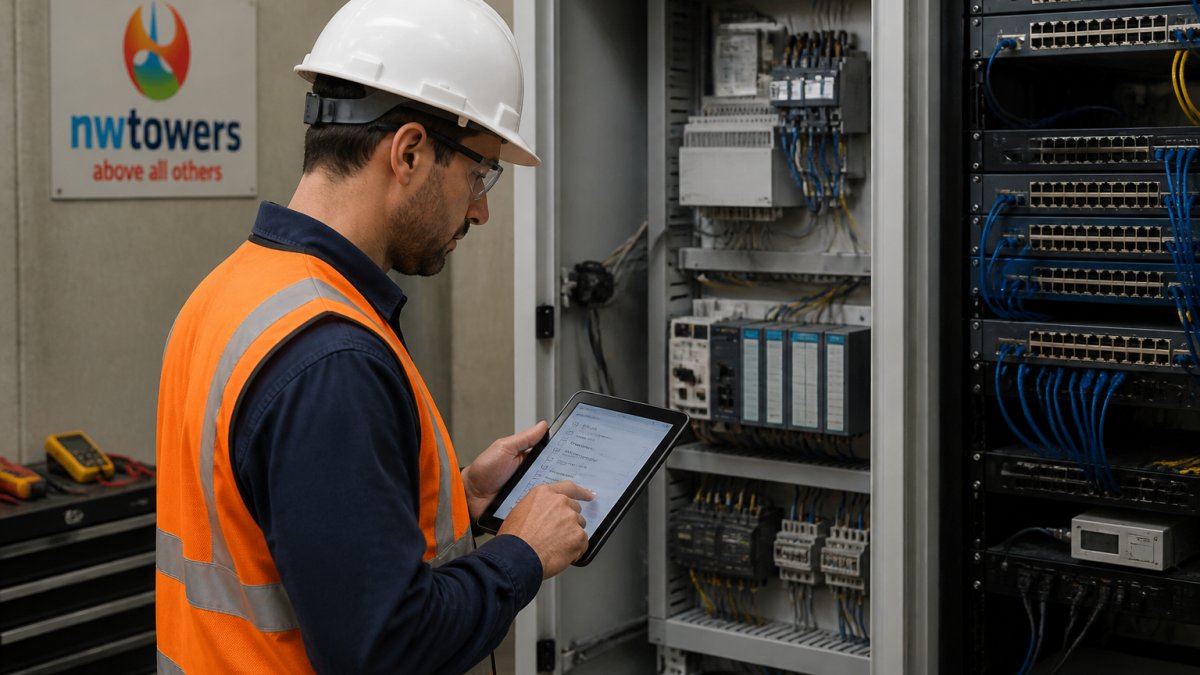
List every device that touches the control network: PLCs, RTUs, HMIs, historians, switches, gateways, and wireless links. For each one, record the make, model, firmware version, and physical location.
What most guides miss is the wireless layer. Radios, antennas, and backhaul links are often left off the inventory, and they are exactly where an attacker enters from outside the fence.
Map how each device talks to the others. Note the protocol, the direction of traffic, and whether the path crosses a firewall or a wireless bridge.
Legacy protocols like Modbus and DNP3 often lack authentication. That is a design fact, not a bug you can patch. The fix is to control who can reach those paths.
| Checklist Item | What to Record | Why It Matters |
|---|---|---|
| Asset inventory | Make, model, firmware, location | You can’t protect what you can’t name |
| Network map | Protocol, direction, path | Shows where traffic can be intercepted |
| Wireless links | Radio, antenna, encryption | Common external entry point |
| Remote access | Vendor and staff logins | Widens the attack surface |
Passive discovery comes first: you listen to network traffic and build a device list without sending a single probe. Only after that baseline should you consider active scanning, and only inside an approved window.
OT vulnerability scanning tools split into two groups. Passive tools watch mirrored traffic and identify devices by their behavior. Active tools send queries to devices, which is faster but riskier on old hardware.
Our rule at Northwest Towers is simple: passive by default, active only for specific devices with operations watching. If a device can’t tolerate a probe, don’t probe it.
A few practical points:
Score every finding on two axes: how likely it is to be exploited, and how much damage it would cause. A flaw on an internet-facing gateway outranks the same flaw on an isolated HMI.
Use a simple scale so the whole team can read it:
| Priority | Likelihood | Impact | Action Window |
|---|---|---|---|
| Critical | High | Production stop | Fix this week |
| High | High | Local disruption | Fix this month |
| Medium | Low | Limited effect | Next maintenance window |
| Low | Low | Minimal | Track and review |
The real difference between a useful assessment and a shelf document is this table. It tells your team what to do Monday morning.
A good ICS vulnerability assessment report example has five parts: scope, method, findings, priorities, and a fix plan with owners and dates. Anything longer gets filed and forgotten.
Keep each finding to a short block:
Write for two readers at once. The controls engineer needs the device detail. The plant director needs the risk and the date. Put both in the same block and skip the jargon where you can.
OT vulnerability management best practices only work when they run on a schedule, not as a one-time project. A yearly scan leaves you blind for fifty-one weeks.
Build a simple calendar:
The wireless layer deserves its own slot. Firmware on radios and gateways ages quietly, and a stale link is an open door.
This is where a managed approach pays off. Northwest Towers runs network design, monitoring, and managed services, including Network as a Service, so your team gets proactive alerts on power, weather, and environmental anomalies without adding headcount. If you’d rather not build this in-house, our managed network services team can run the monitoring layer for you. For sites that need purpose-built hardware, our industrial wireless products are built for dust, vibration, and extreme weather.
It is a structured review of the devices, networks, and software that run your operational technology, done to find weaknesses before an attacker or a failure exploits them. Unlike an IT scan, it accounts for legacy equipment, proprietary protocols, and uptime requirements. The output is a prioritized list of findings with recommended fixes, not a pass or fail grade.
Start with passive monitoring that copies traffic from a SPAN port or network tap instead of probing devices directly. Schedule any active scanning during planned maintenance windows, and test on a lab replica first. For controllers that cannot tolerate any probing, rely on configuration review, vendor advisories, and firmware version checks rather than live scans.
A usable report lists each affected asset with its location and function, the specific weakness found, a severity rating tied to operational impact, and a concrete remediation step with an owner and target date. Add a network diagram, an executive summary of the top risks, and an appendix of raw findings. Keep the language plain enough that plant managers can act on it.
Run a full assessment at least once a year, and repeat it after any major change: new equipment, firmware updates, network expansion, or a shift in vendor support. Continuous passive monitoring fills the gaps between full reviews, and a quarterly check of critical assets keeps the picture current without a full project each time.
Every OT network changes. New devices get added, firmware drifts, and wireless links quietly age out of support. A one-time scan can’t keep up with that.
Northwest Towers helps industrial teams stay ahead of it with rugged wireless hardware, network design and audits, and fully managed Network as a Service with little to no capital investment. We handle the monitoring and anomaly detection so your team isn’t chasing alerts.
Contact us to scope a connectivity and monitoring plan for your site.