

Last Updated: October 15, 2026
The benefits of encryption for IIoT devices start with a hard operational reality: unencrypted industrial traffic is readable by anyone who reaches the network, which is why the benefits of encryption for IIoT devices begin with confidentiality. At Northwest Towers, we design rugged wireless equipment for mining, ports, construction, and utility sites, and we treat encryption as a design requirement rather than an add-on.
Every connected sensor, programmable logic controller, and gateway adds another entry point. Industrial operations have expanded that surface quickly: remote monitoring, autonomous haulage, asset tracking, and cloud analytics all depend on data moving between devices, gateways, and servers.
That traffic crosses wireless links, public networks, and third-party cloud systems, none of which an operator fully controls. The NIST Cybersecurity Framework guidance on protecting operational technology treats identity, data protection, and detection as core functions for exactly this reason.
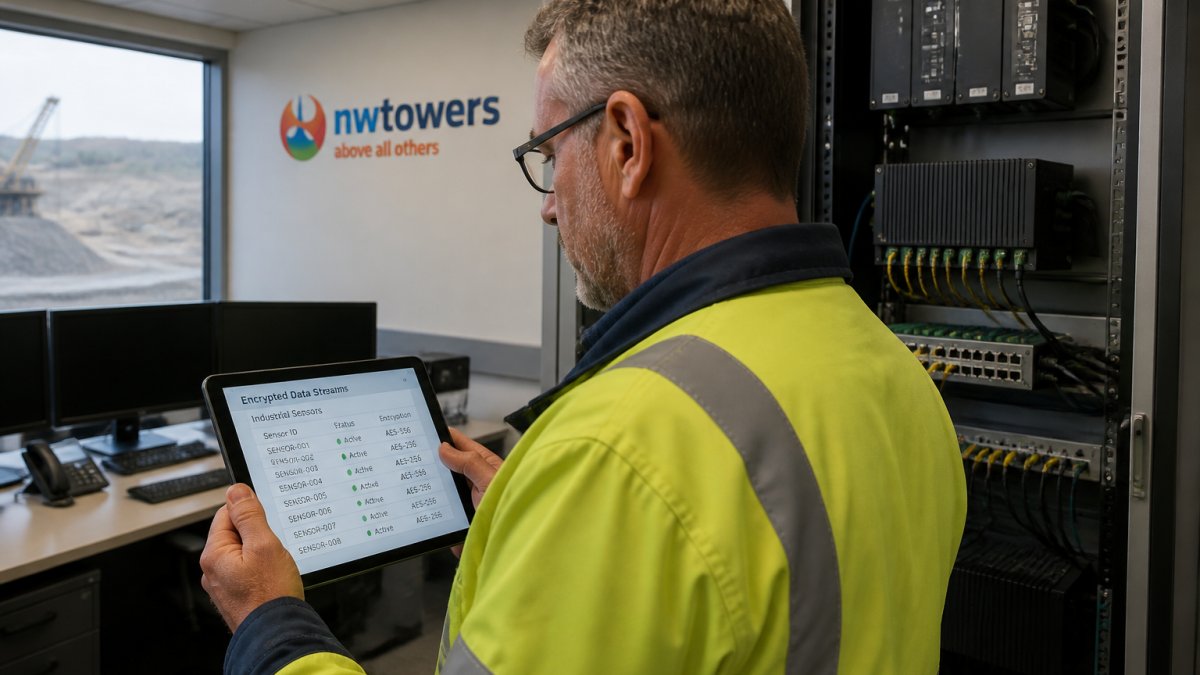
Encryption at rest and in transit are two distinct controls that protect data at different points in its life. Encryption in transit secures data while it moves between devices and systems. Encryption at rest protects data while it sits in storage on a device, gateway, or server. Industrial networks need both, because a reading is vulnerable at each stage. But in IIoT, the lifecycle is longer and more fragmented than in consumer IoT: data moves from sensors to gateways, to edge systems, to cloud platforms, and sometimes to backups and maintenance laptops.
Most industrial data follows a predictable path, and each stage has its own encryption requirements and common failure points:
A common pattern is to encrypt the radio link and the cloud connection but leave gateways, backups, and maintenance workflows unprotected. That leaves multiple entry points for data exposure.
On the wire or over the air, encryption protects against interception and tampering. Wireless links are the obvious exposure, but wired segments inside a plant are not automatically safe: anyone with physical access to a switch or cable can capture traffic.
Common approaches include:
The choice depends on the device and the threat model. A battery-powered sensor on a remote pad may only support a lightweight cipher suite, while a mains-powered gateway can run full TLS with certificate authentication.
Devices buffer data when a link drops, and gateways often cache readings before forwarding them. That stored data needs protection too. Full-disk encryption on gateways and secure enclaves on constrained devices keep cached readings confidential if hardware is lost, stolen, or decommissioned.
A common mistake is encrypting the radio link and leaving the gateway’s local storage wide open. Anyone who walks off with that gateway has your production history. The same applies to maintenance laptops and backup drives.
Encryption is only as strong as the keys behind it, and IIoT encryption key management is where most industrial deployments quietly fail. Keys must be generated securely, distributed to devices without exposing them, rotated on a schedule, and revoked when a device is retired or compromised.
At industrial scale, that is an operational problem, not a cryptographic one. A site with hundreds of devices spread across pits, ports, and substations cannot rely on manual key handling. Practical requirements include:
Plan for recovery before you need it. A failed rotation during a production shift is an outage, not a security event.
IIoT security best practices combine encryption with identity, segmentation, and monitoring. Encryption alone does not stop an attacker who can authenticate as a legitimate device. Layer the controls, and tailor them to industrial operations where safety and uptime are paramount.
Every device should prove who it is before it joins the network. Certificate-based authentication gives each device a unique identity that can be verified and revoked. Shared passwords and default credentials remain a leading cause of industrial breaches because they cannot be traced to a single device.
In IIoT, authentication also supports safety: a rogue device sending false control commands could trigger unsafe conditions. Strong device identity ensures that only authorized devices can participate in control loops.
Segment operational traffic from corporate IT and from the public internet. A sensor that only needs to reach one gateway should not be able to reach the billing system.
For legacy equipment that cannot support modern encryption, segmentation is especially critical. Place older devices behind a gateway that encrypts traffic on their behalf, and isolate them from the rest of the network. This phased approach avoids rip-and-replace while still improving security.
Encryption protects the integrity of control data, which directly affects safety. If an attacker can alter sensor readings or control commands, they can cause equipment damage or endanger personnel. Encryption with message authentication ensures that data is not tampered with in transit. This is not just about confidentiality; it is about trust in the data that drives physical processes.
Keys must be provisioned, rotated, revoked, stored, and recovered across large fleets and long-lived equipment. Manual key handling does not scale. Automated provisioning, scheduled rotation, and clear revocation paths are essential. Plan for recovery: a failed rotation during a production shift is an outage, not a security event. Centralized inventory mapping every key to a device identity is a practical necessity.
Encryption has costs: latency, CPU, memory, and energy. For battery-powered sensors, energy use may limit cipher choices. For real-time control, latency may rule out certain protocols. Measure these impacts against your operational requirements. The goal is not maximum cryptography but sufficient cryptography that meets security needs without disrupting production. A measurement plan should include latency, CPU and memory use, energy consumption, downtime risk, and compliance impact.
Many industrial environments contain equipment that cannot be replaced. Retrofitting encryption may be impossible on some devices. In those cases, use gateway-based protection: the gateway encrypts traffic on behalf of legacy devices. Combine this with segmentation and staged rollouts. A phased approach that protects what you can while planning for future upgrades is more realistic than a forced rip-and-replace.
| Control | What It Protects | Where It Applies |
|---|---|---|
| Encryption in transit | Data confidentiality on the link | Wireless and wired segments |
| Encryption at rest | Stored sensor and gateway data | Devices, gateways, servers |
| Device authentication | Device identity and authenticity | Network join and session setup |
| Network segmentation | Lateral movement after a breach | Plant, site, and cloud boundaries |
| Key management | Long-term cryptographic integrity | Full device lifecycle |
Secure industrial wireless networks depend on hardware that can actually run modern cryptography in harsh conditions.
Northwest Towers designs and manufactures rugged industrial wireless products for exactly these environments. We support that hardware with network engineering, integration, deployment, and managed services, including Network as a Service, so teams can run encrypted industrial networks without adding dedicated IT staff.
If you are planning a deployment, start with our industrial wireless networking products.
The most damaging mistakes are organizational, not technical. Teams encrypt the radio link and forget the gateway cache, or they deploy strong cryptography and then share one key across the fleet.
Watch for these:
Industrial networks are only getting more connected, and every new device widens the surface an attacker can probe. Encryption, paired with strong device identity and disciplined key management, is what keeps production data and control traffic out of the wrong hands.
Northwest Towers builds the rugged wireless hardware and provides the network engineering, deployment, and managed services to run encrypted industrial networks in the field. Contact us to plan a deployment that treats security as a design requirement from day one.
Encryption for IIoT devices protects sensitive operational data from interception and unauthorized access, ensuring confidentiality and integrity across industrial networks. It secures data both in transit and at rest, which is critical for compliance and safety in sectors like mining and manufacturing. Encryption also enables device authentication, preventing rogue devices from joining the network. These benefits reduce the risk of cyberattacks that could disrupt production or compromise safety systems.
Encryption uses cryptographic algorithms to convert data into unreadable ciphertext, so only authorized parties with the correct decryption keys can access it. For IIoT devices, this means sensor readings, control commands, and firmware updates remain confidential even if intercepted. It also ensures data integrity by detecting tampering. This protection is vital for industrial operations where data drives critical decisions and safety protocols.
Encryption can introduce latency and increase processing overhead, especially on constrained devices with limited power and memory. However, lightweight encryption algorithms and hardware accelerators minimize these effects. For industrial applications, the security benefits typically outweigh the minor performance trade-offs, and proper network design can ensure real-time requirements are met without compromising on encryption.
Effective IIoT encryption key management involves generating, distributing, rotating, and revoking keys securely throughout their lifecycle. Use hardware security modules or secure elements to store keys, and automate rotation to reduce human error. For large-scale deployments, a centralized key management system ensures consistency and simplifies audits. This approach prevents key compromise and maintains the integrity of the encryption scheme.