
Last Updated: October 17, 2026
A private 5G network architecture is the complete set of radio, core, transport, and management elements that deliver dedicated cellular connectivity to one organization, independent of public carrier infrastructure, what separates a private 5G network from a slice of someone else’s public network.
Here’s what most vendor decks skip: architecture decisions get made at the site survey, not the datasheet. Northwest Towers designs rugged industrial wireless hardware for exactly those environments.
Below, we break down each layer of a private 5G network architecture, how data moves end to end, and the trade-offs that decide whether a deployment holds up in harsh conditions.
A private 5G network consists of four functional groups: user equipment, the radio access network, the 5G core, and the management and security layer. Each has a distinct job and fails differently.
For industrial sites, the UE list is usually the surprise: connected devices multiply fast once operations teams see what real-time data can do, so plan capacity for growth, not today’s headcount.
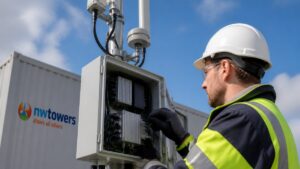
The RAN is the visible part of the network: radio nodes mounted on poles, masts, or structures, each converting fiber or copper transport into a 5G radio signal. In a private deployment, RAN placement drives coverage and capacity more than any software setting.
Radio units need line of sight where possible, clean power, and physical protection, rugged enclosures and mounting hardware that survive vibration and dust, placed around moving container stacks at a port.
The baseband unit processes the digital signal; the radio unit handles the analog side. Some architectures split these across a fronthaul link for flexible processing placement; others integrate them into one unit, simplifying remote sites with limited shelter space.
User equipment connects through SIM-based authentication, so access control starts at the device, not the firewall, a distinction that matters for OT teams tracking which device sits on which network segment.
The 5G core separates the control plane, which handles authentication and session setup, from the user plane, which carries actual traffic.
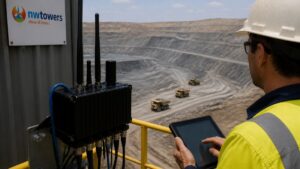
Network slicing extends the idea: one physical network, multiple logical networks, each with its own performance and security profile. A mine can run a slice for autonomous haulage and another for crew communications without either competing for resources.
The practical payoff is traffic segregation: OT traffic stays isolated from business traffic, simplifying security review and troubleshooting.
Non-standalone deployments anchor the 5G radio to an existing 4G core. They’re faster to stand up and cheaper to start, but you inherit 4G limitations on latency and slicing.
Standalone deployments use a native 5G core throughout. They cost more and take longer, but deliver the latency and slicing industrial automation depends on. For a temporary site, non-standalone can make sense; for a permanent automated facility, standalone is usually right.
Spectrum choice shapes everything downstream. Licensed spectrum gives exclusive use and predictable performance, but costs money and requires coordination. Unlicensed spectrum needs no license but carries no interference protection.
For industrial sites, the decision comes down to how much interference you can tolerate near heavy electrical equipment. Unlicensed bands near a processing plant can be crowded; licensed or shared arrangements buy the predictability automation needs.
| Model | RAN Location | User Plane | Control Plane | Management | Typical Fit |
|---|---|---|---|---|---|
| Fully on-premises | Site | Site | Site | Site | Single critical facility, strict data residency, in-house telecom staff |
| Cloud-hosted core | Site | Regional cloud | Regional cloud | Cloud | Multi-site consistency, thin local IT |
| Hybrid (split) | Site | Site | Regional cloud | Cloud | Low-latency control loops plus central management |
| Operator-managed | Site (operator-owned or shared) | Operator core | Operator core | Operator portal | Organizations that want cellular expertise without building it |
Fully on-premises. Every function sits in the facility, often in a hardened enclosure near the radio head-end.
Cloud-hosted core. The RAN stays on site, but user-plane and control-plane functions run in a regional cloud or centralized data center.
Hybrid (split) architecture. The 5G core’s control-plane and user-plane separation makes this model practical.
Operator-managed. A carrier or integrator owns and operates the core and often the RAN, and the enterprise buys connectivity as a service.
The deployment model and core generation interact. Non-standalone anchors 5G radios to an existing 4G core, faster and cheaper to start, but inheriting 4G limits on latency and slicing. Standalone uses a native 5G core throughout and delivers the latency and slicing industrial automation depends on. Non-standalone is most common in cloud-hosted and operator-managed models where speed to service matters; fully on-premises and hybrid designs for permanent automation usually go standalone.
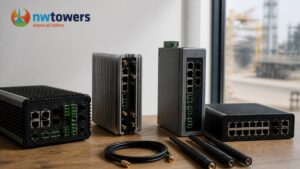
Whichever model you choose, the RAN side is where the physical deployment lives, and ruggedized hardware and site engineering decide whether the topology actually performs. Northwest Towers’ industrial wireless networking equipment is built for the mounting, power, and interference conditions these topologies run into, and our network engineering team designs the RAN placement each model depends on.
Private 5G network design starts with three numbers: required coverage area, peak device density, and interference floor. Get those wrong and no amount of core tuning saves the deployment.
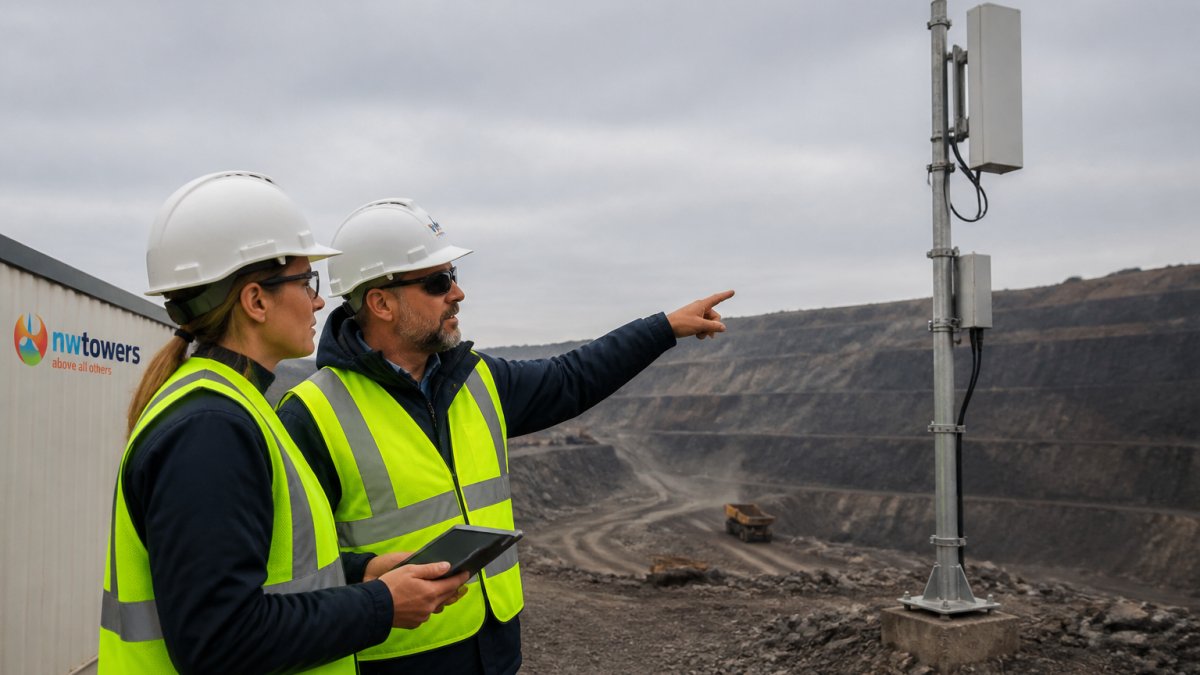
Harsh sites punish optimistic planning. A design that works in a warehouse often fails at a processing plant, which is why we push for a site survey before any bill of materials.
Use this sequence when choosing a topology:
Most private 5G write-ups treat security as a bullet list and resilience as a benefit. The useful version is a walkthrough: what happens to a packet from the moment a device powers on, and what happens when each element in that path fails.
The key architectural point: identity lives at the SIM, not the firewall. Access control starts at device attach, which is why a compromised business laptop cannot simply join the control-loop slice.
A private 5G threat model has four realistic entry points:
Encryption applies at multiple layers: the air interface, the transport between RAN and core, and the application payload. The transport segment is commonly the least scrutinized, especially when fronthaul crosses third-party fiber.
Resilience is a set of answers to specific failures:
Hardware that survives these failure scenarios is the foundation of any resilience plan. Northwest Towers’ rugged antennas and industrial networking equipment are engineered for the power, environmental, and mounting conditions radio sites actually face, and our managed services team can own the monitoring and failover planning that keeps the architecture running.
A private 5G network architecture has three layers. The radio access network (RAN) connects user equipment, industrial IoT devices, and 5G devices through radio nodes, radio units, and baseband units. The 5G core handles authentication, session management, and routing across the control plane and user plane. Spectrum, whether licensed, unlicensed, or shared, feeds the radio layer. On top sit network management, security, and access control tools. In practice, most industrial sites also connect the private 5G network to the existing enterprise network for data center and cloud access.
The core private 5G network components are radio nodes and antennas, baseband units, the 5G core (which may run on-premises, in the cloud, or hybrid), SIM credentials for devices, spectrum access, and a network management system. Industrial deployments add rugged enclosures, power protection, and backhaul links. You also need user equipment: sensors, cameras, vehicles, and handhelds with 5G modules. Northwest Towers designs and supplies rugged antennas and networking hardware for these environments, and can run the whole stack as a managed service.
A standalone (SA) deployment uses a 5G core with 5G radio, so it delivers the full feature set: network slicing, low latency, and native support for industrial IoT. A non-standalone (NSA) deployment anchors the 5G radio to an existing 4G core, which speeds up rollout but limits slicing and traffic segregation. For greenfield industrial sites, SA is usually the better long-term choice. NSA makes sense when you already have a 4G core and need coverage fast. The decision affects cost, timeline, and which automation use cases you can support.
Start with a site survey that maps obstructions, metal structures, and sources of electromagnetic interference such as processing plants and heavy machinery. Define capacity by device count and throughput needs, not just coverage area. Plan for mobility if vehicles or crews move across the site. Choose spectrum that matches your interference profile, and design redundancy so a single radio node failure does not drop a critical control link. Northwest Towers offers network design, audit, and monitoring services to validate the plan before deployment.
The private 5G core connects to the enterprise network through a secure gateway or direct peering, usually over fiber or licensed microwave backhaul. Traffic segregation and network slicing keep operational technology traffic separate from corporate IT traffic, while access control governs which devices and users can cross between them. Many operators deploy edge computing at the site so real-time data from connected devices is processed locally, with only summary data sent to the cloud. This keeps latency low and reduces backhaul load.
Yes. Unlicensed and shared spectrum options let enterprises build a private 5G network without buying licensed airwaves, which shortens procurement and lowers entry cost. The trade-off is interference risk: unlicensed bands are shared with other users, so coverage and reliability depend heavily on site conditions and radio planning. Shared spectrum offers more predictability but still requires coordination. For harsh industrial sites with high electromagnetic interference, a licensed or shared approach with careful private 5G network design is usually more reliable than unlicensed-only.