
Last Updated: October 1, 2026
Industrial connectivity is the network layer carrying data between sensors, machines, vehicles, and control rooms at mining, port, construction, and manufacturing sites. When it fails, dispatch loses sight of haul trucks, telemetry stops, and SCADA alarms arrive late or not at all.
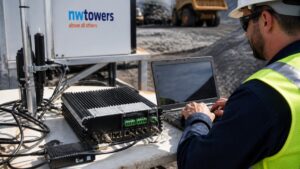
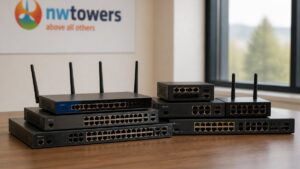
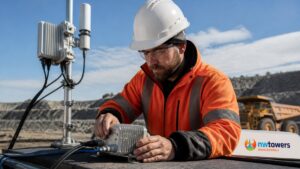
Northwest Towers designs and manufactures rugged industrial wireless products for mining, construction, ports, and utilities, backed by network engineering, deployment, and managed services.
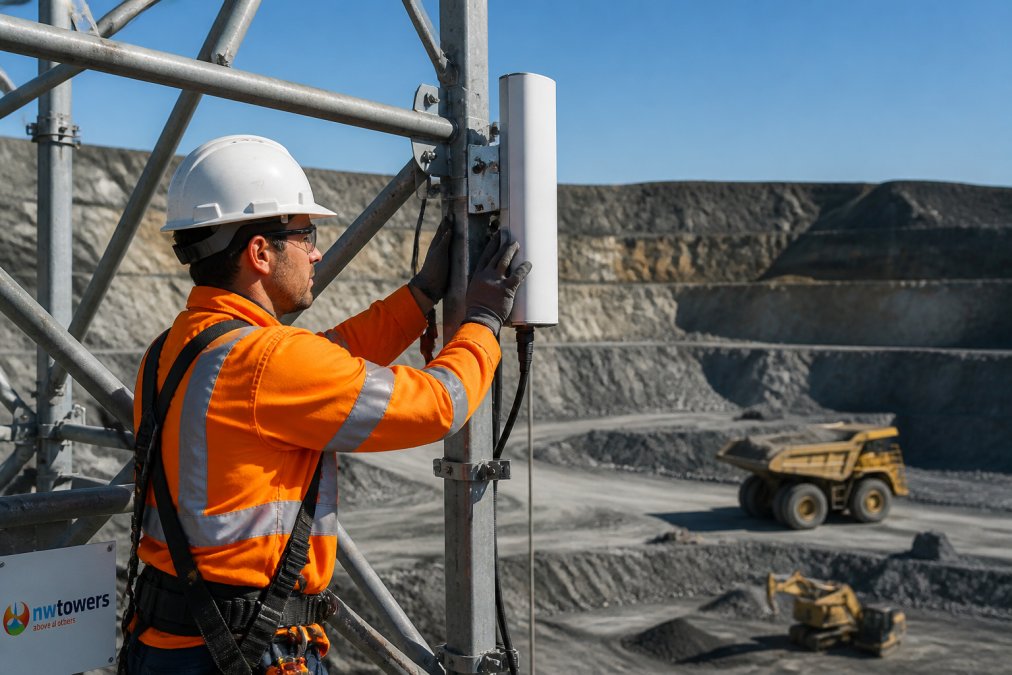
The hardware is IP-rated for dust, vibration, temperature swings, and mobile equipment. Northwest Towers also runs network design, audit, and monitoring, with partnerships across leading outdoor networking hardware and software providers. Their Network as a Service offering delivers fully managed connectivity with little to no capital investment, which matters when budget flow favors operating expense over outright purchase. Northwest Towers partners with leading outdoor networking hardware and software providers, including Avigilon, Axis Communications, Ceragon, and Cisco.
Every deployment starts with a custom site assessment, adding a planning step before hardware ships. That is a tradeoff for teams wanting a same-week rollout, but it is why the hardware holds up where generic equipment does not. Pricing depends on site count, environment, and service tier, so request a quote.
Industrial Network as a Service (NaaS) is a subscription model in which a provider designs, deploys, monitors, maintains, and refreshes the network while the operator pays an ongoing fee instead of buying equipment outright. Connectivity is consumed like fleet-management or condition-monitoring software: as an operating expense tied to a service level, not a capital asset depreciated over seven years.
Connectivity pricing is quoted per deployment, but the underlying cost drivers are consistent:
Most procurement teams compare sticker prices and stop there. A more useful comparison runs across a five-year horizon and captures four buckets:
| Model | Upfront Cost | Ongoing Cost | Best For | Watch Out For |
|---|---|---|---|---|
| Buy hardware outright | High | Maintenance, spares, refresh | Permanent sites, 5+ year horizon, in-house field techs | Capital approval cycles; stranded assets if the site closes early |
| NaaS subscription | Low | Monthly or annual fee | Temporary sites, lean IT teams, sites with defined lifespans | Contract terms, exit costs, and whether refresh is genuinely included |
| Hybrid | Medium | Partial subscription | Multi-site rollouts, phased modernization | Managing two vendors and a split support boundary |
Our view: if your finance team treats connectivity as operating expense, NaaS removes the biggest adoption barrier and converts an unpredictable capital and maintenance burden into a predictable line item. If you already own spares, employ field techs, and expect the site to run for a decade, buy. Either way, the network is not the end product, it exists to keep on-site industrial and infrastructure SaaS applications, from fleet management to condition monitoring, running without interruption. See how Northwest Towers NaaS handles design, deployment, monitoring, and refresh under one agreement.
AVEVA CONNECT is a cloud-based, vendor-neutral industrial intelligence platform that unifies data from disparate site systems into a single infrastructure SaaS environment. Its open architecture works across existing hardware, which matters for mixed-vendor sites built through acquisitions and phased upgrades. What determines whether a rollout succeeds is the integration workflow underneath it, where connectivity stops being an IT topic and becomes an operations topic.
A typical multi-site integration follows a repeatable sequence:
Steps 3 and 4 are where connectivity decisions get made, and the steps most integration plans under-specify.
Not every data stream needs the same network. Treating them identically either overbuilds the network or starves the critical loop.
| Workload | Typical Latency Sensitivity | Bandwidth Profile | Practical Implication |
|---|---|---|---|
| Autonomous haulage and machine control | Very high, sub-second round trip | Moderate but constant | Requires low-jitter, low-latency paths; satellite is generally unsuitable for the control loop |
| Safety interlocks and proximity detection | Very high | Low | Must survive backhaul loss; keep the decision at the edge |
| SCADA and process control | High | Low to moderate | Tolerant of brief buffering but not of reordering |
| Condition monitoring and vibration | Low | Bursty, high volume | Ideal candidate for store-and-forward and batch upload |
| Video analytics and surveillance | Low to moderate | Very high | Bandwidth-hungry; often processed at the edge with only events sent upstream |
| Business reporting and dashboards | Low | Low | Can ride the same link as everything else |
For teams that would rather not own the road, Northwest Towers NaaS delivers the design, deployment, monitoring, and refresh as a single managed service, so the connectivity layer is engineered to the latency and bandwidth profile each SaaS workload actually requires.
GTT Multi-Site Connectivity is a managed, AI-enabled wide-area networking service providing secure, high-bandwidth links across geographically dispersed industrial facilities. Its unified visibility dashboard and AI-driven traffic routing reduce the burden on internal network teams. The limitation is scope: GTT focuses on wide-area connectivity between sites, not the on-site wireless layer where mobile equipment, telemetry, and edge devices actually connect. Treat it as the backbone, not the whole network.
The NIST Cybersecurity Framework offers a useful starting point for segmenting operational technology from business systems, and CISA guidance on securing operational technology covers the field-level controls that apply to distributed industrial networks.
The right choice depends on site lifespan, internal IT capacity, and how your finance team prefers to spend.
| Situation | Recommended Approach |
|---|---|
| Temporary site, defined end date | NaaS subscription |
| Permanent site, existing field techs | Purchase rugged hardware |
| Multi-site data unification | Cloud infrastructure SaaS plus resilient backhaul |
| Global enterprise WAN | Managed multi-site service |
Reliable connectivity enables real-time monitoring of equipment, environmental conditions, and worker locations. When networks stay up, telemetry from gas sensors, proximity detection systems, and fatigue monitoring tools reaches supervisors without delay. That means hazards get flagged before they become incidents. On construction sites, connected systems can track crane loads and exclusion zones. In mining, underground networks support communication between surface control rooms and crews below. The result is fewer blind spots, faster emergency response, and a safer work environment overall.
Buying equipment means you own the hardware, handle installation, and manage maintenance with your own IT staff. NaaS, or Network as a Service, shifts that burden to a provider who designs, deploys, monitors, and supports the network for a subscription fee. NaaS typically requires little to no upfront capital investment, which helps operations with tight budget cycles. You also get proactive monitoring and faster response to failures. The trade-off is a recurring cost and some dependency on the provider for day-to-day network management.
Standard networking gear fails quickly in extreme conditions. Ports expose equipment to salt spray, constant vibration from container handlers, and wide temperature swings. Mining sites deal with dust, electromagnetic interference near processing plants, and mobile equipment that moves constantly. Rugged wireless networking equipment is built with IP-rated enclosures, vibration-resistant mounts, and antennas tuned for challenging RF environments. That durability translates to fewer outages, longer hardware lifespan, and less time spent on truck rolls to replace failed units.
Remote sites face three recurring problems: limited backhaul options, harsh physical conditions, and thin IT staffing. Fiber often is not available, so operators rely on microwave, private LTE/5G, or LEO satellite for backhaul. Equipment must survive temperature extremes, dust, and vibration. And when something fails, getting a technician on site can take days. A managed connectivity model with remote monitoring and spare parts staging addresses all three. Proactive anomaly detection catches power fluctuations or weather-related degradation before a full outage occurs.