
Last Updated: September 25, 2026
Public cellular networks were built for population density, not for a mine pit, a port terminal, or a substation at the end of a gravel road, which is why alternatives to public cellular for remote sites keep coming up. That mismatch is the core problem behind the search for alternatives to public cellular for remote sites. At Northwest Towers, we build wireless hardware for exactly these environments, and the pattern we see is consistent: coverage maps promise more than physics delivers.
Here is what actually goes wrong. Carrier towers are sited to serve the most subscribers per dollar, which means remote sites sit at the edge of a cell, often 15 to 30 kilometers out. At that range, signal strength drops, throughput falls off a cliff, and latency spikes. Add a processing plant full of electric motors and you get interference that no consumer-grade router was designed to handle.
The commercial side is just as frustrating. Data caps throttle you mid-shift. Carrier-grade priority does not exist on a consumer plan, so your traffic competes with everyone else’s. And when a tower goes down, you have no recourse except a support ticket.
That leaves four realistic paths: build a private network, use satellite, run fixed wireless, or combine them. Below, we break down each option, what it costs in practice, and where it fails.
A CBRS private network deployment is the closest thing to owning your own cellular carrier without buying spectrum at auction. CBRS is a band of shared spectrum that the FCC opened for general use, and it lets industrial operators run a private LTE network on their own property.
The appeal is control. You decide who connects, what traffic gets priority, and how the network behaves under load. Latency stays low because the core network sits on site rather than 30 kilometers away. Security improves too, since data never leaves your premises. Maintaining this level of localized infrastructure remains the most reliable strategy for mission-critical operations, even as mobile connectivity evolves through flexible esim data plans that offer alternative ways to bridge gaps in coverage.
What most guides miss is the effort involved. A private LTE build needs spectrum access coordination, core network hardware, radios, antennas, and someone who understands signal propagation across your specific terrain. Rocky ground, steel structures, and elevation changes all reshape where coverage actually lands.
That is where a managed approach pays off. Northwest Towers handles network design, audit, and monitoring, and our NaaS model lets you stand up a private network with little to no capital investment. If you already run Cisco gear on site, we integrate rather than rip and replace.
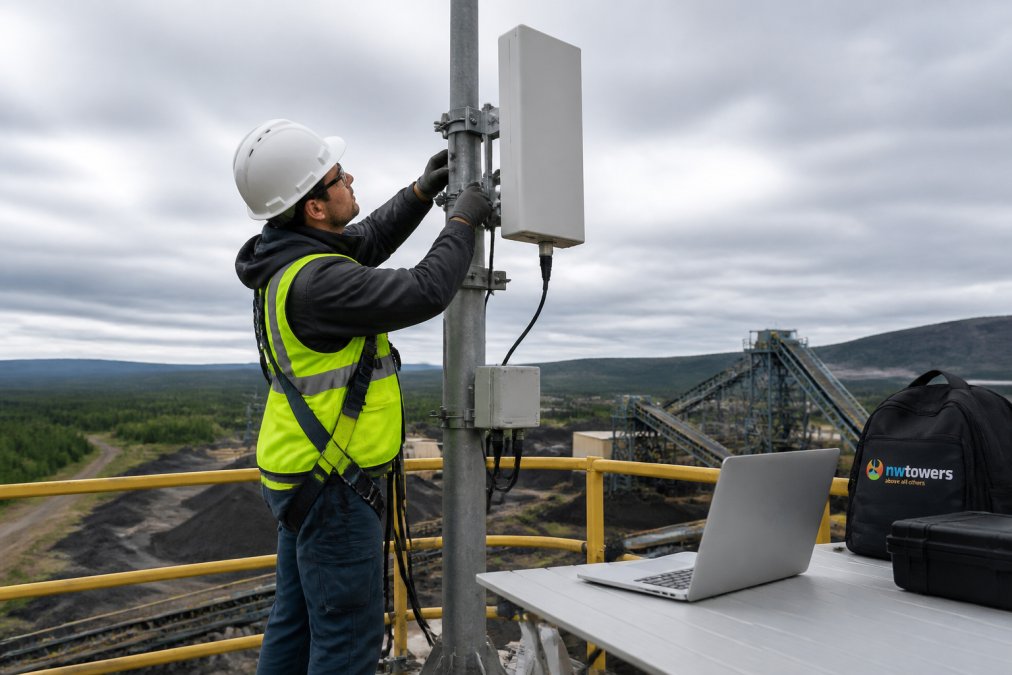
Satellite internet is the fastest option to deploy when there is no terrestrial infrastructure at all, and low-earth orbit services have changed what is possible. Low-earth orbit services have changed what is possible, delivering genuinely usable latency for most industrial monitoring.
The catch is that satellite is a shared pipe. Weather affects it, and heavy rain or snow can degrade service. Geostationary providers sit much farther out, so latency is higher, but they offer broader coverage and predictable monthly costs.
For mission-critical control loops, satellite should be your backup, not your primary. It works well for telemetry, camera feeds, and administrative traffic. It works poorly for real-time machine control where jitter matters.
A mesh radio network is the right answer when you need coverage across a large, awkward site rather than a single point. Instead of one big transmitter, mesh nodes relay traffic between each other, so a signal can hop around a stockpile, past a crusher building, and out to a distant pump station.
Fixed wireless access takes a different approach. Providers use cellular aggregation to deliver service to a fixed location, with various plan options. It is simple and fast to deploy, but performance depends entirely on how close you are to a carrier tower. That is the same dependency you were trying to escape.
The honest comparison:
| Option | Typical Starting Cost | Best For | Main Limitation |
|---|---|---|---|
| Private LTE / CBRS | Quote-based | Full site control, low latency | Design and coordination effort |
| LEO satellite | $120/month | Sites with zero infrastructure | Weather sensitivity, shared bandwidth |
| GEO satellite | $49.99/month | Telemetry, baseline coverage | High latency |
| Fixed wireless | $89.99/month | Quick temporary setups | Reliant on carrier tower proximity |
| Mesh radio | Quote-based | Large, obstructed sites | Node placement planning |
Industrial wireless design best practices come down to one principle: design for the worst day, not the average one. Heat, dust, vibration, and voltage sags are normal operating conditions in mining, ports, and construction, not exceptions.
Start with a real site survey. Measure signal strength in decibels at the points that matter, not at the gate. Identify obstructions, reflective surfaces, and interference sources.
A few rules that hold up in the field:
Cost is where most remote connectivity decisions get made badly, because the sticker price hides the operational cost. A cheap radio that fails in February and takes three weeks to replace is not cheap. The right way to compare alternatives is total cost of ownership across a five-year horizon, broken into four buckets: capital equipment, installation and commissioning, recurring service or spectrum fees, and downtime exposure.
The cheapest network is the one that stays up. Compare alternatives on five-year total cost of ownership, not on the first invoice.
Most guides treat regulatory, power, and security as footnotes. In practice, these three constraints decide whether a remote network survives its first year. This section covers what the listicles skip.
CBRS operates under a shared access framework administered through the FCC’s spectrum access system. That means your base stations must register with a Spectrum Access System administrator and coordinate with incumbent users, including fixed satellite service and grandfathered naval radar operations in coastal zones. Skipping registration creates legal exposure and interference complaints that can force an unplanned shutdown.
Remote sites often run on generators, solar, or unreliable grid feeds, and every radio, switch, and antenna adds draw. A realistic power budget starts with a load inventory: base station, backhaul radio, edge compute, switches, and any heating or cooling for enclosures. Cold-weather sites need heater circuits, which can double the enclosure draw.
A non-public network is not automatically a secure network. Private LTE improves the picture because traffic stays on site and devices authenticate to your own core, but DIY remote setups introduce risks that enterprise guides rarely address.
Do not assume that because a network is private, it is secure. The most common breach path at remote sites is a default password on a device nobody remembered to change.
The hardest part of replacing public cellular at a remote site is not picking a technology. It is designing a network that holds up when the weather turns, a component fails, and the nearest replacement part is hours away.
Satellite internet provides coverage where cellular towers are absent. For industrial sites, private LTE networks using CBRS spectrum offer dedicated connectivity. Mesh radio networks can extend coverage across challenging terrain. Each option has trade-offs in latency, cost, and setup complexity. Evaluate your site’s power availability, data needs, and budget to choose the best fit.
Private LTE gives you dedicated bandwidth, lower latency, and full control over security and traffic prioritization. Unlike public cellular, you are not competing with consumer traffic or subject to data caps. For remote industrial operations, this means reliable performance for critical applications like video surveillance, automation, and real-time monitoring. CBRS spectrum makes private LTE more accessible without expensive licensed spectrum.
Yes, mesh radio networks excel in environments with obstacles like buildings, hills, or underground tunnels. Nodes automatically route data around blockages, providing redundancy and failover. They are ideal for mobile equipment, temporary sites, and areas where running cable is impractical. However, mesh networks require careful design to avoid latency buildup and ensure adequate throughput for your applications.
CBRS (Citizens Broadband Radio Service) operates in the 3.5 GHz band, providing unlicensed or priority access spectrum for private networks. It enables high-bandwidth, low-latency connectivity without the cost of licensed spectrum. For remote sites, CBRS private network deployment allows you to build a customized LTE network that covers your operational area, supports IoT devices, and integrates with existing IT systems.
Start with a site survey to identify obstacles, interference sources, and coverage requirements. Choose the right frequency band and antenna type for your environment. Plan for redundancy and failover to maintain uptime. Use ruggedized, IP-rated equipment to withstand harsh conditions. Implement network monitoring and security measures. Finally, work with experienced integrators to ensure proper deployment and optimization.