
Last Updated: September 20, 2026
A mesh radio network is a decentralized wireless system in which every node relays traffic for the others, so no single tower or base station has to carry the whole site. At Northwest Towers, we build these networks for open pit mines, ports, and remote industrial sites where a dropped link stops production. In an open pit, the difference between a working mesh radio network and a dead one usually comes down to antenna selection, not radio power.
That matters because pit walls, haul trucks, and excavators constantly reshape the radio environment. A link that works at shift start can fade by afternoon.
Topology in a mesh network is fluid, not fixed. Each node contains a transceiver that both sends its own data and forwards packets for neighbors, using dynamic routing to pick the best path at any moment. Add a truck, lose a shovel, and the network reroutes around it.
Three characteristics define the topology:
Self-healing and self-forming are the two properties that make mesh viable in a pit. The network forms links automatically when nodes power on, then repairs itself when a node fails or moves out of range. No technician reconfigures anything.
This is what infrastructure-less means in practice: no fiber, no trenching, no fixed backhaul to a pit wall that will be blasted next week. Redundancy comes from the number of paths available, not from spare hardware sitting in a warehouse.
Here is the part most deployments get wrong. In an open pit, the antenna’s vertical beam width does more for link reliability than transmit power, receiver sensitivity, or radio brand. A mesh radio network with narrow vertical coverage loses half its nodes the moment equipment climbs a ramp or a shovel swings its boom.
Mining haul trucks, drills, and loaders move through constant elevation changes. A radio mounted on a truck bed sits low; a repeater on a pit rim sits high. A narrow vertical pattern cannot hold both at once.
A wide vertical beam width keeps the link margin stable as nodes move through elevation changes, and in practice that can improve usable radio performance by 10X or more compared with a narrow-pattern antenna on the same radio. The gain is not extra power. It is fewer dropped packets, fewer retransmissions, and less time spent chasing intermittent faults.
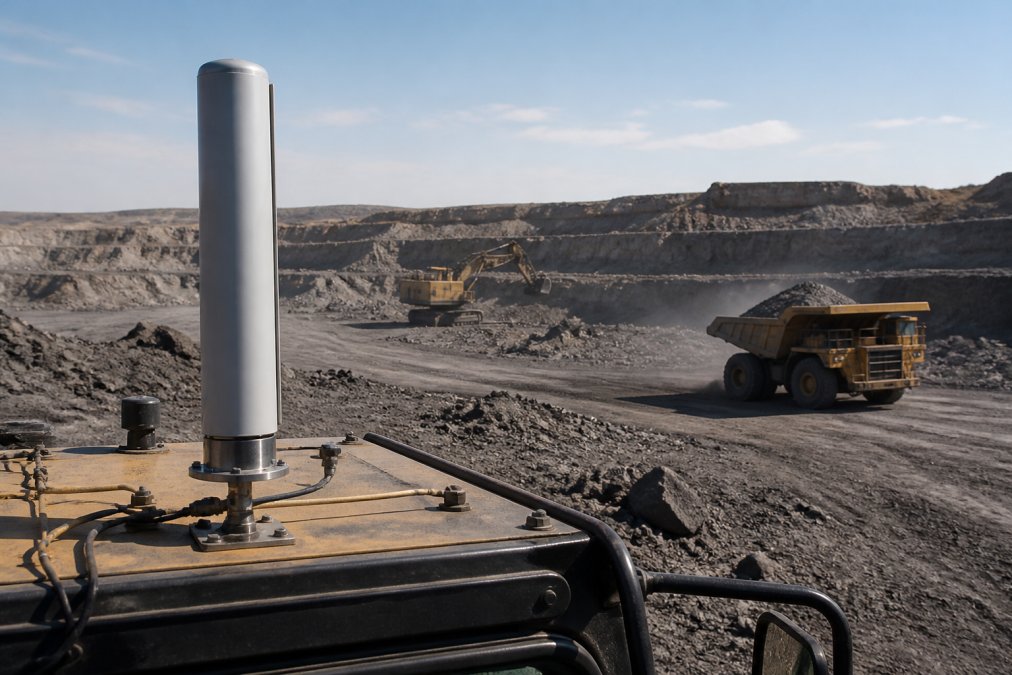
Think about what a narrow beam does when a truck crests a ramp. The antenna’s pattern points at the horizon, the receiving node sits below it, and the signal falls off the edge of the pattern. The radio still reports a connection, but throughput collapses and latency spikes.
Designing an industrial wireless mesh network means matching four things: radio frequency band, antenna pattern, power budget, and protocol stack. Get the antenna wrong and the other three cannot compensate. Get the power budget wrong and the network dies at 3 a.m. in February.
Most industrial mesh deployments run in unlicensed bands, commonly 900 MHz, 2.4 GHz, and 5 GHz, with licensed narrowband options for telemetry. The trade-off is straightforward:
Power budgeting is where solar and battery nodes quietly fail. A node’s draw depends on transmit duty cycle, receive time, processing load, and, critically, how often it has to retransmit because a link is marginal. A wide vertical beam antenna reduces retransmissions, which lowers average current draw and extends battery life between charges.
Gain and beam width trade off against each other. A high-gain antenna focuses energy into a narrow pattern; a lower-gain antenna spreads it wider. For mobile nodes in a pit, the wider vertical pattern usually wins because it holds the link through elevation change, even though peak gain is lower.
Interoperability is the other constraint. Mesh nodes need a common protocol stack and, ideally, standards-based data links so equipment from different vendors can share the network. Ask any supplier which standards their radios support before you commit, and test mixed-vendor links on site rather than assuming a datasheet claim will hold.
Off-grid operations are where mesh earns its place. A mesh radio network carries dispatch, telemetry, video, and asset tracking across sites with no commercial power and no fiber. The same architecture serves open pit mines, remote well pads, port terminals, and large construction sites.
Typical deployments include:
Peer-to-peer networks route traffic directly between nodes, with no central access point. Infrastructure-based networks depend on fixed towers and backhaul. Most industrial sites run a hybrid: mesh for mobile coverage, fixed infrastructure for high-bandwidth backhaul.
|
Network Type |
Best For |
Main Trade-Off |
|---|---|---|
|
Peer-to-peer mesh |
Mobile fleets, changing terrain |
Throughput falls as hop count rises |
|
Infrastructure-based |
Fixed high-bandwidth backhaul |
Coverage limited to tower range |
|
Hybrid mesh |
Most industrial sites |
Requires careful design work |
Every hop adds latency and reduces usable throughput, because each relay node must receive, process, and retransmit the packet. In a pit with mobile nodes, hop count changes constantly as trucks move in and out of range. A link that runs two hops at shift start may run four by mid-shift, and video that streamed cleanly at 8 a.m. may stutter by noon.
Because every node can relay traffic, mesh networks need encryption at the link layer and, ideally, at the application layer. A compromised or spoofed node can otherwise inject traffic or draw packets away from their intended path. Most industrial deployments use standards-based link encryption plus authenticated routing, and treat node physical security, locks, tamper detection, and controlled key distribution, as part of the design rather than an afterthought.
Compliance is the topic most mesh guides skip, and it is the one that can shut a site down. In the United States, radio equipment must be authorized by the Federal Communications Commission equipment authorization procedures, and operators must stay within the power, frequency, and duty-cycle limits of the band they use.
The hard part of a mesh radio network in an open pit is not the radio. It is the antenna pattern, the power budget, and the compliance paperwork that most deployments treat as an afterthought. Wide vertical beam width is the single change that most often turns a marginal link into a working one, and it costs less than adding radios.
A mesh radio network connects nodes directly to each other, with each node acting as a transceiver that can send and receive data. When a node fails, dynamic routing automatically finds another path, so the network keeps running without a central tower. This peer-to-peer design is ideal for off-grid industrial sites where running cable is impractical.
Mobile equipment moves up and down steep benches, so a narrow vertical beam can easily lose line-of-sight to the antenna. A wide vertical beam width keeps the signal locked on the receiver even as trucks climb or descend. This reduces dropped packets and keeps mission-critical data flowing, which can improve radio performance by up to 10X compared to narrow-beam alternatives.
Yes, but you must comply with FCC rules for the frequency band and power limits. Most industrial mesh systems operate in unlicensed bands like 900 MHz, 2.4 GHz, or 5 GHz, which have specific power and duty-cycle restrictions. For licensed bands, you need a coordinator license. Always check the current FCC regulations and consult a spectrum manager before deployment.
Mesh networks can suffer from increased latency as hop count grows, and throughput may drop because each hop shares bandwidth. They also require careful power budgeting for battery-powered nodes. However, for many industrial sites, the self-healing and infrastructure-less benefits outweigh these trade-offs, especially when using antennas with wide vertical beam widths to maintain strong links.