
Last Updated: September 23, 2026
Rugged networking equipment is hardware engineered to keep data moving in conditions that destroy standard commercial gear: extreme temperatures, constant vibration, dust, moisture, and electromagnetic interference. At Northwest Towers, we build and deploy this class of hardware for mining, ports, construction, and utility sites, where a dropped link can halt production.
The difference between industrial-grade and office-grade hardware is not marketing. It is the difference between a switch rated for a climate-controlled closet and one rated to survive a -40°F night on a pit wall.
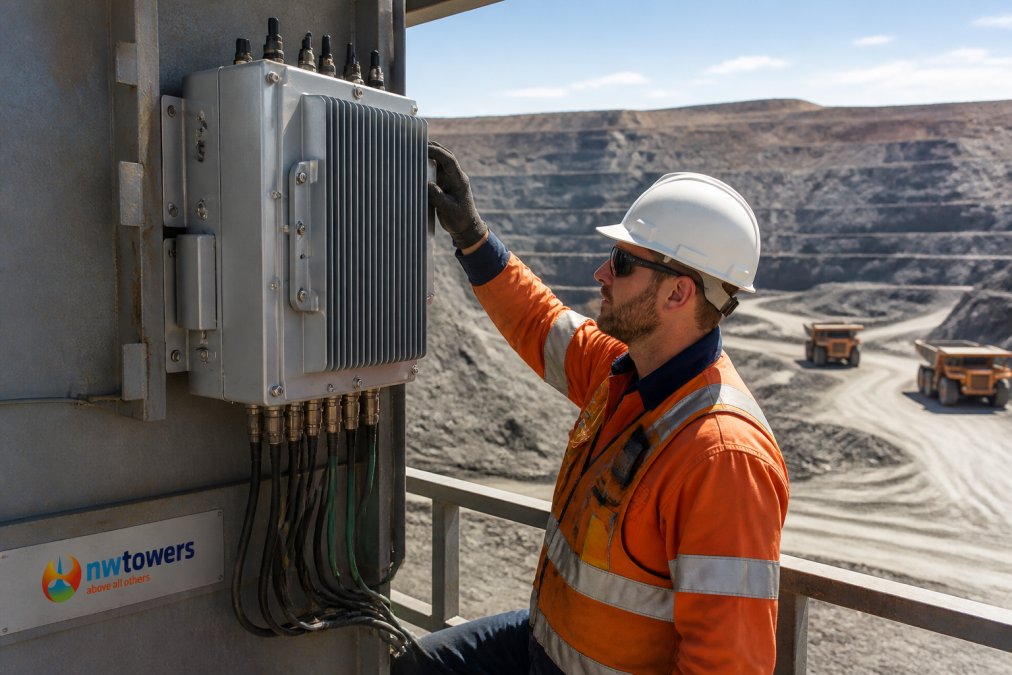
Three stressors separate rugged hardware from commercial hardware.
Temperature swings break solder joints and cook power supplies. Industrial gear is specified across wide operating ranges, often -40°F to 167°F, while commercial switches typically assume a comfortable office.
Vibration from crushers, drills, and haul trucks loosens connectors and fatigues circuit boards. Vibration resistance comes from locking connectors, conformal coating, and fanless designs with no moving parts.
Ingress is dust and water. The IP rating tells you how well a device keeps both out. An IP67 enclosure survives temporary submersion; an IP30 office switch does not survive a single dusty shift.
Commercial networking optimizes for cost and throughput in clean rooms. Industrial networking optimizes for uptime in places where a technician cannot reach the hardware for days.
That single constraint drives everything else: wider temperature specs, DIN rail or rack mount options, redundant power inputs, and managed network features that let you diagnose a problem remotely instead of driving to a remote site. For operations teams, the question is never “which switch is fastest” but “which switch is still running in February.”
Industrial Ethernet switches are the backbone of any rugged network, moving traffic between sensors, cameras, radios, and control systems. They come in managed and unmanaged versions, and the choice matters more than most buyers expect.
Unmanaged switches are plug-and-play. They work fine for a simple daisy chain of devices and cost less, but they offer no visibility, no redundancy, and no remote troubleshooting.
Managed switches support Layer 2 and Layer 3 functions: VLANs, network redundancy protocols, port monitoring, and traffic prioritization.
PoE delivers power and data over one cable, which simplifies installation for cameras, access points, and sensors. In harsh environments, PoE removes the need for a separate power run to every device, cutting both cost and failure points.
Rugged wireless access points and cellular routers extend the network where cable cannot reach: across a pit, along a conveyor, or between temporary job site trailers. These devices need the same environmental hardening as switches, plus antennas built for the environment.
Best practices for industrial network deployment start with designing for failure, not assuming it away. Every remote site should assume a link will drop and plan the recovery before it happens.
Build redundancy into both the hardware and the path. Dual power inputs, ring topologies, and backup cellular links keep a site running when one component fails.
| Layer | What It Protects | Practical Step |
|---|---|---|
| Physical | Hardware from heat, dust, vibration | IP-rated enclosures, DIN rail, fanless design |
| Network | Traffic from intrusion and loss | VLANs, redundancy protocols, firmware updates |
| Operational | Uptime and response time | Remote monitoring, managed service, spare parts plan |
Compliance is where many industrial network projects quietly fail. Equipment that works perfectly in testing can be rejected at commissioning if it lacks the right certifications, and retrofitting certified gear into an uncertified enclosure voids the rating. The following standards are the ones procurement teams actually check before a purchase order is signed.
The IP rating, defined under the IEC 60529 standard, tells you how well an enclosure resists dust and water. The first digit covers solids (0-6) and the second covers liquids (0-9K). An IP67 device survives temporary immersion; an IP30 office switch does not survive a single dusty shift.
MIL-STD-810 is the Department of Defense test standard that many industrial buyers reference even outside defense work, because it defines repeatable methods for shock, vibration, humidity, salt fog, and temperature cycling. A device tested to MIL-STD-810 methods has documented evidence it survives the stressors that break commercial gear.
Sites with heavy motors, welders, and variable-frequency drives generate electromagnetic interference that can corrupt data. Equipment must be tested for both emissions and immunity under the FCC’s rules for unintentional radiators, documented in FCC equipment authorization procedures. Industrial buyers should also look for IEC 61000-4 immunity testing, which covers electrostatic discharge, radiated fields, and electrical fast transients, the disturbances that actually occur on a factory floor.
For areas with combustible dust or gas, equipment must meet additional classification requirements. In the United States, the Class/Division system (and the newer Zone system) defines where equipment can be installed; the OSHA hazardous location standards govern how employers must handle these environments. Devices intended for these areas carry markings such as UL 121201 or ATEX/IECEx certification.
For deployments that need certified hardware out of the box, our network equipment is built to these standards and documented accordingly.
Most rugged hardware guides stop at the spec sheet. The harder questions come after deployment: who maintains it, how long it lasts, and how it connects to the wider data systems a modern operation depends on. This is the gap the top-ranking articles leave open, and it is where projects actually succeed or fail.
Firmware updates on rugged gear are not the same as pushing patches to an office switch. Many industrial devices sit behind air-gapped networks or on cellular links with limited bandwidth, and a failed update can brick a device that takes a day to reach. A practical pattern is staged rollout: update one switch in a ring, verify it rejoins, then proceed.
Industrial equipment often stays in service for a decade or more. Field-repairability matters because a failed power supply or fan tray should be a swap, not a truck roll with a replacement chassis. Look for modular power inputs, hot-swappable transceivers, and DIN-rail devices that can be replaced without rewiring the enclosure.
A network designed without a lifecycle plan becomes a patchwork of incompatible gear. Vendors publish end-of-life (EOL) and end-of-support dates; tracking those dates against your deployment schedule prevents the surprise of a failed device you can no longer replace. When a platform reaches EOL, plan the migration during a scheduled outage rather than during a failure.
Integration with IIoT ecosystems is the newer challenge. Many sites run legacy protocols, Modbus, PROFINET, EtherNet/IP, alongside modern cloud-based analytics platforms. Rugged networking bridges the gap by prioritizing industrial control traffic while carrying sensor and telemetry data to the cloud. That requires a network that can segment device classes, apply quality-of-service rules, and stay secure while doing it.
Northwest Towers supports customers through this phase with network engineering, integration, deployment, and managed services, including Network as a Service, so operations teams are not left maintaining hardware they never planned to own. Our Rugged 4G / 5G Mobile Router for Private Mobile Networks is designed for exactly these lifecycle and IIoT integration scenarios.
Rugged networking equipment is engineered to operate in extreme temperatures, high vibration, dust, and moisture. Key differences include wide operating temperature ranges, shock and vibration resistance, high IP ratings for ingress protection, fanless designs, and EMI shielding. Standard commercial hardware typically operates in climate-controlled offices and fails quickly when exposed to industrial conditions. Rugged gear also supports DIN rail or rack mount installation and often includes redundant power inputs for continuous uptime in critical infrastructure.
Look for IP ratings (IP67 or higher for outdoor deployments), wide temperature ranges (often -40°C to 75°C), and compliance with shock and vibration standards like MIL-STD-810. For hazardous locations, equipment may need Class I Division 2 certification. In the United States, FCC Part 15 covers electromagnetic interference. Utilities and critical infrastructure operators may also require compliance with NERC CIP cybersecurity standards. Always verify the specific certifications match your site’s environmental and regulatory requirements before deployment.
Vibration loosens connectors, cracks solder joints, and causes intermittent failures in standard hardware. Extreme temperatures accelerate component degradation, cause thermal shutdowns, and reduce battery life in backup systems. In mining and construction, equipment mounted on vehicles or near heavy machinery experiences constant shock. Rugged networking equipment uses conformal coating, locking connectors, and solid-state components to maintain data integrity and uptime. Without these protections, network drops lead to lost production data and safety system failures.
Industrial ethernet switches support wider temperature ranges, higher ingress protection, and DIN rail mounting. They include redundant power inputs, alarm relays, and support for industrial protocols like Modbus TCP and PROFINET. Commercial switches prioritize port density and cost. Industrial switches prioritize reliability in harsh environments, often with fanless designs and extended MTBF ratings. For manufacturing floors, outdoor cabinets, or remote sites, industrial switches prevent the downtime that commercial gear cannot survive.