
Last Updated: October 6, 2026
Data security in mining operations is the practice of protecting the operational, business, and personal information that mine sites generate, transmit, and store. It covers everything from drill telemetry and haul truck dispatch data to payroll records and assay results.
At Northwest Towers, we build wireless networks for mines, so we see where data actually travels across a site. That view shapes this guide. Below, we explain why encryption is necessary for mining operations, where your data is exposed, and how to close those gaps without slowing production.
Three things make mining data hard to protect:
Encryption is the control that keeps data unreadable if someone intercepts it. Without it, every wireless hop is an open door.
Mining operations attract cyber threats because they combine high-value data with weak network perimeters. A single site may run dispatch systems, environmental sensors, and corporate email over shared links.
Attackers look for three things:
A modern mine depends on connected systems. Dispatch, ventilation, dewatering, and conveyor control all rely on network links. When those links are unencrypted, an attacker can read traffic or inject false commands.
The risk is not theoretical. The Cybersecurity and Infrastructure Security Agency tracks industrial control system incidents across critical infrastructure, and mining sits squarely in that group. A stoppage at a remote site can take hours to diagnose and days to fully recover.
Mining data moves through more paths than most teams realize. Mapping those paths is the first step toward protecting them.
The main flows include:
Each flow has a different risk profile. Video and telemetry are high volume and time sensitive. Contracts and assay results are low volume but high value.
| Data Flow | Sensitivity | Encryption Priority |
|---|---|---|
| Sensor to control room | Medium | High |
| Vehicle to dispatch | Medium | High |
| Site to cloud | High | Critical |
| Site to office | High | Critical |
| Remote engineer access | Critical | Critical |
Encryption is a core control because it protects data both at rest and in transit. It converts readable information into ciphertext that only authorized systems can unlock.
Two states matter most:
For mining, data in transit deserves the most attention. Wireless backhaul between a pit and a control room can span several kilometers. Anyone with the right gear and a clear line of sight can attempt to intercept that signal.
Strong encryption closes that gap. Modern standards such as AES-256 and TLS 1.3 keep traffic unreadable even if captured. The National Institute of Standards and Technology publishes the cryptographic standards most industrial networks follow.
Encryption also supports compliance. Auditors increasingly ask for evidence that sensitive data is protected in transit and at rest. A documented encryption policy answers that question directly.
Secure remote access for mining operations means giving engineers and vendors a way into site systems without opening the whole network. Done badly, it becomes the weakest link.
Remote access shows up in several forms:
Each session needs three things: strong authentication, encryption, and logging.
Start with multi-factor authentication. A password alone is not enough for a system that controls production. Add a VPN or zero-trust gateway so traffic is encrypted end to end. Then log every session so you can trace who did what.
Northwest Towers designs rugged wireless equipment and managed network services for exactly these environments. Our field-proven gear is built to handle dust, vibration, and extreme weather, and our Network as a Service model gives sites a fully managed link without heavy capital spend.
Encryption key management is the process of creating, storing, rotating, and recovering the keys that unlock encrypted data. In mining, this process must account for legacy equipment, intermittent connectivity, and the fact that a lost key can halt production just as surely as a lost network link.
Most mining teams underestimate this step. Keys are easy to generate and hard to govern across remote sites, contractors, and mixed-vendor equipment.
A workable approach for mine sites includes:
Legacy OT devices often lack native key management support. A programmable logic controller (PLC) from 2005 may only accept a static key, and some sensors ship with default credentials that cannot be rotated.
Remote sites with intermittent connectivity complicate rotation. If a key rotation fails mid-process because a link drops, you can lock yourself out of your own data. A common pattern is to stage new keys on-site, verify them locally, then activate during a scheduled maintenance window.
Contractor access adds another layer. A vendor performing diagnostics on a crusher may need temporary access to encrypted telemetry. Rather than sharing a permanent key, issue short-lived credentials or use a key broker that grants access only for the session duration.
Recovery is the part teams skip. If a key is lost and no backup exists, encrypted production data is gone for good. But recovery speed matters too: a remote site that loses access to dispatch data may have only hours before haul truck routing degrades.
Define a recovery time objective (RTO) for each data category. Control commands and dispatch data might need recovery within one hour; historical assay results might tolerate 24 hours. Test your recovery process against those targets, not just once a year but after any major network change.
Northwest Towers builds rugged wireless equipment and managed network services for exactly these environments. Our industrial wireless products are designed to support encrypted links and integrate with your existing key management workflows, so you can rotate keys without taking the site offline.
Industrial wireless network security focuses on the edge of your network: the antennas, access points, and links that connect remote equipment. This is where mining data is most exposed, and where encryption choices directly affect uptime, latency, and safety-critical response times.
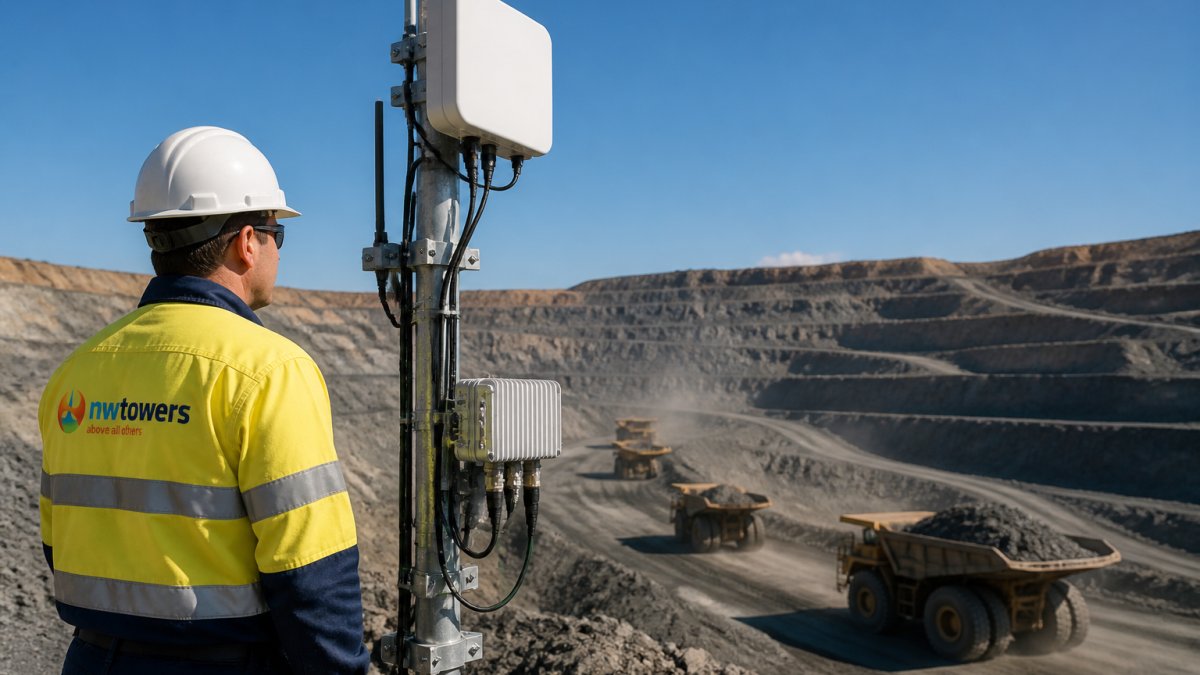
Hardening the edge comes down to a few practical steps, but each involves trade-offs that generic advice ignores:
Encryption adds computational overhead and, in some configurations, latency. For most business data, production reports, email, invoices, this is negligible. For control loops that require sub-50-millisecond response times, such as autonomous haul truck braking or ventilation fan adjustments, heavy encryption can introduce unacceptable delay.
A common pattern is to use hardware-accelerated encryption on modern access points and gateways, which keeps latency low. Where legacy devices cannot handle encryption, isolate them on a segmented network and encrypt only the gateway link to the control room.
Bandwidth is another constraint. Video from remote cameras and high-frequency sensor telemetry can consume significant throughput. Encrypting everything at full resolution may saturate a wireless backhaul link.
Physical security matters too. An access point in an unsecured cabinet can be tampered with, and a stolen device can reveal keys if not properly protected. Lock enclosures, log access, and inspect hardware after severe weather. In open-pit mines, dust and vibration can degrade antenna performance, which may cause links to drop and fall back to less secure modes if not configured correctly.
Northwest Towers builds antennas and networking gear for these exact conditions. Our IP-rated industrial wireless products are designed for harsh sites, and our monitoring services flag power and environmental anomalies before they become outages. That means fewer surprises and less time spent troubleshooting.
If you want a network that holds up underground, in the pit, and at the port, contact us to talk through your site.
Mining operations generate sensitive data that travels between remote sites, control rooms, and cloud platforms. Encryption keeps that data unreadable if it is intercepted, protecting proprietary geological surveys, production figures, and equipment controls. It also helps satisfy legal and contractual obligations for safeguarding confidential information. Without encryption, a single compromised link can expose operational data, allow unauthorized access to automated systems, and disrupt production across multiple sites.
Prioritize anything that could harm safety, production, or finances if exposed. That includes geological and exploration surveys, production and assay results, equipment control commands, video feeds from autonomous haulage, employee and contractor records, and financial or contract documents. Operational data moving between sensors and control systems deserves the same treatment as corporate files, because altered sensor readings can trigger unsafe machine behavior or costly downtime.
Encryption adds processing overhead, which can slow older control equipment if it is not sized correctly. It also introduces key management duties: lost keys can lock a site out of its own data, and poorly managed certificates can cause outages during shift changes. Latency on long wireless backhauls may increase slightly if encryption is applied at the wrong layer. These trade-offs are manageable with hardware-accelerated encryption, careful network design, and a documented key recovery process.
Use a centralized key management system that issues, rotates, and revokes keys automatically, with offline backups stored in a physically secure location. Set certificate lifetimes short enough to limit exposure but long enough to avoid constant re-issuance at remote sites. Document who can access keys and test recovery procedures at least twice a year. For industrial wireless networks, choose equipment that supports standard key exchange protocols so replacements and new sites can be brought online without custom configuration.
Mining networks keep getting more connected, and every new link adds another place data can leak. Closing those gaps takes the right hardware, the right encryption, and a team that knows industrial sites. Northwest Towers offers rugged wireless products, full network design and audits, and managed Network as a Service with little to no capital investment. Get started with Northwest Towers and build a mining network that protects your data from the pit to the cloud.