
Last Updated: October 9, 2026
Most guides skip the hard parts: who owns the pole, who signs the permit, or who tests the splice at 2 a.m.
The work is growing fast. Federal programs like the Broadband Equity, Access, and Deployment Program are pushing fiber into rural areas that never had it.
Below, we break down each stage of a telecommunications construction project, from route planning to fiber placement to how underground and aerial crews split the work.
Project planning sets the route, budget, and schedule before any crew breaks ground. A project manager starts with the service area, then works backward to figure out what the build needs.
Good planning answers three questions early:
Get these wrong and the build stalls. A common mistake is scoping the route before checking existing utilities, which leads to costly mid-build redesigns.
Route planning maps the path from the network hub to each endpoint. Planners study terrain, existing infrastructure, and environmental limits, including wetlands, rail crossings, and highway crossings, since each adds cost and delay.
Site preparation comes next: crews clear access roads, stage materials, and mark utility lines before digging. On rural broadband builds, this can take longer than the cable placement itself.
Route planning is iterative. The first route rarely survives contact with the field, so expect at least one redesign.
Permitting is the slowest part of most builds. Every jurisdiction has its own rules, fees, and timelines. A single project can need dozens of separate approvals.
Rights-of-way are the legal agreements that let crews work on land they do not own, including public roads, private property, and rail corridors. Utility coordination means working with every other owner of buried or overhead infrastructure, from power companies to gas lines.
Fiber optic construction is the process of installing fiber-optic cable and connecting it so light signals travel cleanly from end to end. It has two main phases: placing the cable, then splicing and testing it. The details below decide whether a span passes acceptance.
Cable placement puts the fiber in the ground, on poles, or in conduit, depending on terrain, cost, and existing infrastructure. Aerial placement is faster where poles already exist. Underground placement costs more upfront but holds up better in storms. Direct-buried cable is cheapest on open rural ground but offers the least protection and hardest repair access. Conduit costs more initially and pays back on the first upgrade because new cable can be pulled without re-digging.
A practical selection sequence most planners use:
Aerial crews use lashing to bind fiber to a strand, or ADSS cable that supports itself; both require a make-ready survey first.
Bend radius is the quiet killer on fiber jobs. Cable bent tighter than its minimum radius can pass a visual inspection and still fail months later as microbends accumulate loss. Crews use bend-radius guides at every handhole and pedestal.
Splicing joins two fiber ends so light passes through with minimal loss. Fusion splicing uses an electric arc to weld the glass; mechanical splicing aligns the ends with a gel or index-matching fluid.
A splice trailer typically carries the fusion splicer, cleaver, stripping tools, and splice tray. Each splice is protected and documented by fiber number, tray position, and measured loss. A bad splice shows up as signal loss that worsens over distance.
Testing confirms the link works. Crews use optical time-domain reflectometers (OTDRs) to find breaks, measure loss, and locate events along the span. Insertion loss and reflectance matter most.
Every splice and span gets documented before the network goes live. The as-built package typically includes OTDR traces, splice loss reports, fiber assignments, and route maps. Without it, the next crew is guessing.
Fiber to the home brings fiber to individual residences. Fiber to the cell connects cell sites to the core network, which matters as carriers push more traffic through small cells. Both depend on the same placement, splicing, and testing discipline.
When fiber cannot reach a site at all, industrial wireless connectivity bridges the gap. You can review the [LINK: industrial wireless products | /products] to see how a wireless link substitutes for a fiber build.
Underground telecom construction buries the network so weather and traffic cannot touch it. Crews use three main methods, and picking the right one decides cost and schedule.
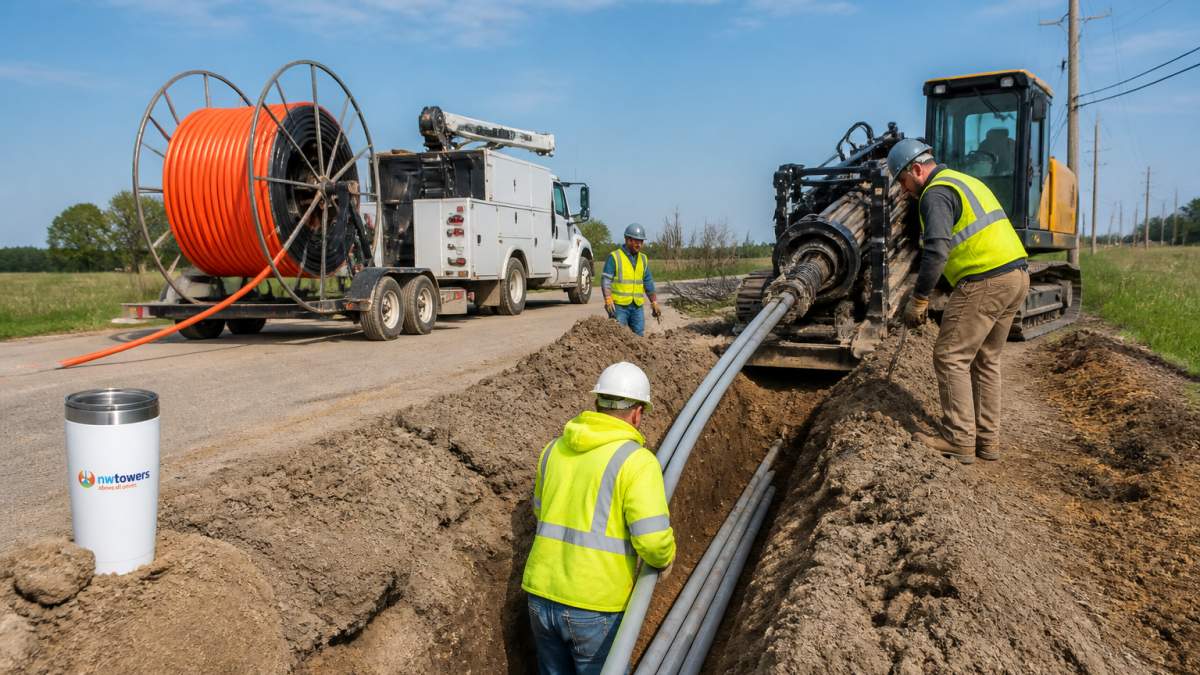
Directional drilling costs more per foot, but it avoids tearing up pavement and rail, and often wins on total cost once restoration is counted. Conduit and duct matter more than people think: a duct bank built with spare capacity lets you add fiber later without digging again, while builds that skip spare ducts pay for it on the next upgrade.
Aerial construction strings cable on existing poles, usually cheaper and faster than digging. The catch is that someone else owns those poles, and they may not have room.
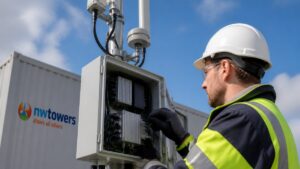
Communication tower work covers new towers, tower modifications, and the antennas and radios mounted on them. Tower crews handle rigging, grounding, and structural checks, and safety rules here are strict for good reason. Industrial wireless connectivity often rides on the same towers, bridging the gap when fiber cannot reach a site.
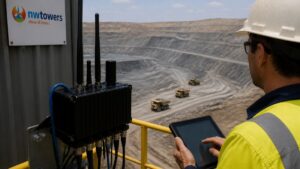
Industrial wireless connectivity is a fixed or mobile wireless link that carries data where fiber is too costly or too slow to install.
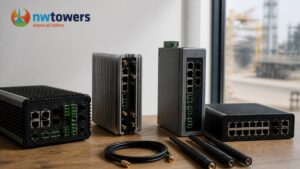
Our products are IP-rated and field-proven in dust, vibration, and extreme weather. We also offer Network as a Service, so a site can get connectivity without a large capital outlay or a dedicated IT team.
Industrial manufacturing facilities use the same approach for automation systems. A reliable wireless link keeps machines, sensors, and control systems talking.
| Method | Best For | Main Trade-Off |
|---|---|---|
| Fiber to the home | Dense residential areas | High upfront trenching cost |
| Fiber to the cell | Carrier backhaul | Depends on core fiber routes |
| Aerial construction | Routes with existing poles | Needs make-ready and pole access |
| Underground construction | Long-term reliability | Slower, higher cost per mile |
| Directional drilling | Road, river, rail crossings | Higher cost per foot |
| Industrial wireless | Remote or temporary sites | Needs clear line of sight |
Safety, testing, and handover decide whether a network works on day one and stays working. A build that skips any of these fails later, usually at the worst time. Here is what a disciplined closeout looks like.
Safety starts with training and daily briefings. Crews working near power, traffic, and heavy equipment follow strict rules. The Occupational Safety and Health Administration sets the standards for trenching, excavation, and electrical work that every telecom crew must follow. The rules that matter most on telecom jobsites:
Quality is built in at defined checkpoints, not inspected at the end:
Each checkpoint gets signed off. If one is skipped, the defect usually surfaces during testing, when fixing it costs far more.
Testing proves the network meets spec. Fiber gets tested for loss and reflectance, typically with bidirectional OTDR traces on every fiber. Wireless links get tested for signal strength and throughput. Every result gets documented. The test package is the evidence that the build meets its design loss budget; without it, acceptance is a matter of opinion.
Handover is the final step. The builder delivers as-built drawings, test results, and warranty terms to the owner. A clean handover package generally includes:
A clean handover saves years of guesswork. A sloppy one means every future repair starts with a site survey.
It comes down to three things:
Our monitoring spots power and weather issues early, so problems get fixed before they take a site down, keeping the network reliable after the crews leave. You can see the hardware that supports that monitoring on our [LINK: product pages | /products].
Telecommunications construction is the civil and network work that creates the physical path for voice, data, and wireless service. It covers outside plant builds such as trenching, conduit and duct installation, directional drilling, aerial cable placement, fiber splicing, communication tower erection, and the testing and handover that close out a project. On industrial sites it also includes the wireless backhaul and coverage layer that connects equipment, vehicles, and control systems to the wider network.
Most projects move through five stages: planning and design, permitting and utility coordination, construction, testing and acceptance, and handover with documentation. Planning sets the route, project scope, and construction schedule. Permitting secures rights-of-way and locates existing utilities. Construction covers trenching, directional drilling, conduit, cable placement, and splicing. Testing verifies loss, continuity, and signal performance before the network is accepted and turned over to operations.
Underground construction buries fiber-optic cable in conduit or duct placed by trenching or directional drilling. It costs more upfront and takes longer to permit, but it is protected from weather and vehicle damage and is the default for new fiber builds. Aerial construction strings cable on existing utility poles, which is faster and cheaper where poles and make-ready work already exist, but it is more exposed to storms, tree contact, and pole-attachment disputes.
Industrial wireless connectivity is planned alongside the fiber build, not after it. Engineers survey the site for coverage gaps, interference sources, and power availability, then design the radio, antenna, and backhaul layout to match the project scope and labor requirements. Temporary links are deployed first so field crews have connectivity on day one, and permanent coverage is cut over once the fiber-optic network and communication tower work are complete.