
Last Updated: November 5, 2026
Quick Summary
RF shielding alternatives for remote wireless sites shift the fix from blocking interference to avoiding it: directional antennas reject off-axis noise, mesh radio networks route around degraded paths, and shielding paint treats shelters without adding structural weight. Use RF shielding materials inside the enclosure and solve the air path with something else.
Standard shielding is a metal barrier that blocks electromagnetic interference from reaching sensitive equipment. At remote wireless sites, that barrier often fails, and the failure has nothing to do with the metal itself.
The problem is the site, not the shielding. A sealed enclosure protects what sits inside it. But the antenna has to live outside, and so does the cable run, the mast hardware, and the cabinet door that gets opened for every service call.
There is a second issue. Shielding stops interference from reaching a device. It does nothing about interference that arrives on the air and collides with your signal before it ever reaches hardware.
That is why operators increasingly look for RF shielding alternatives for remote wireless sites. Below, we break down which alternatives hold up in the field, where traditional materials still earn their place, and how to decide between retrofitting an existing site and building fresh.
RF shielding materials remain the right answer for one job: protecting electronics inside an enclosure. Copper foil, nickel silver, stainless steel mesh, and conductive gaskets all work by reflecting and absorbing electromagnetic radiation before it reaches a circuit board.
Here is how the common materials stack up for remote wireless deployments:
| Material | Conductivity | Corrosion Resistance | Weight | Field Notes |
|---|---|---|---|---|
| Copper foil | High | Poor (oxidizes) | Light | Easy to cut and form on site, but requires protective coating or plating in humid environments. |
| Nickel silver (Cu-Ni-Zn) | Moderate | Good | Moderate | More durable than copper, but lower conductivity means thicker layers for equivalent shielding. |
| Stainless steel mesh | Moderate | Excellent | Heavy | Best for harsh weather, but heavy and difficult to seam properly without specialized tools. |
| Conductive gaskets (silicone with Ag/Cu/Ni fillers) | Varies | Good | Light | Critical for seam and door sealing; compression set and galvanic corrosion are common failure points. |
| Mu-metal | High (low-frequency magnetic) | Poor (brittle) | Moderate | Only for low-frequency magnetic fields; hates bending and requires careful annealing after forming. |
Copper is widely used for general RFI because its high conductivity provides effective attenuation across a wide frequency range. However, at remote sites, bare copper corrodes in humid or salty air, so it is often plated or laminated.
The practical limit is installation quality. One unpainted bolt hole or a gasket compressed past its spec turns a good design into a leak. NASA’s electromagnetic interference control guidance treats bonding and grounding as inseparable from shielding for exactly this reason.
For remote sites, weight and corrosion often override raw conductivity. Stainless steel mesh, for example, survives salt fog and temperature swings but adds structural load and is hard to install without a crane.
RF shielding paint is a conductive coating that turns an ordinary surface into a reflective barrier. It goes on like regular paint and cures into a nickel, copper, or carbon-filled layer that attenuates incoming signals.
For remote sites, the appeal is speed. You can coat a prefabricated shelter, a retrofitted container, or an equipment room without adding sheet metal or structural weight. That matters when everything has to arrive by truck on a haul road.
Three things decide whether shielding paint works:
Watch out: shielding paint is often sold as a complete RFI protection solution when it is really an enclosure treatment. It will not stop interference arriving at the antenna, and it will not fix a badly aimed link.
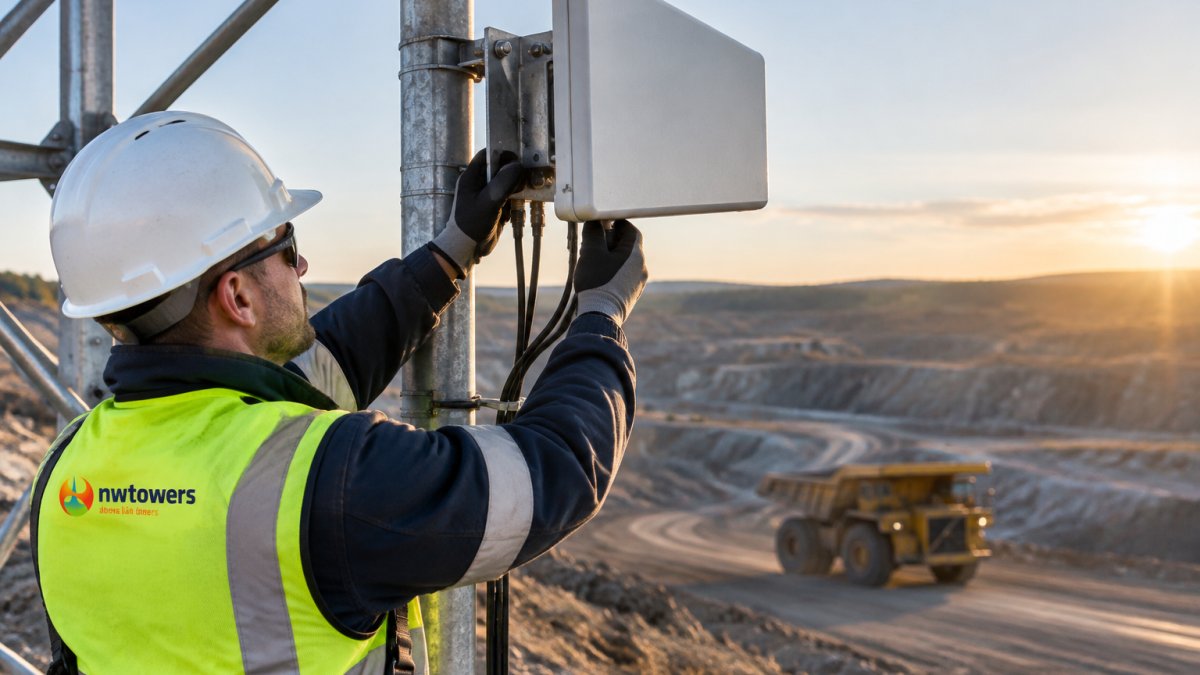
Directional antennas reduce interference by refusing to listen in directions where noise lives. A high-gain directional antenna concentrates energy into a narrow beam, which raises signal strength at the far end and rejects off-axis interference at the near end.
This is often an effective interference mitigation move at remote sites. Instead of shielding everything, you point the link away from the noise source. A sector or panel antenna aimed at a distant repeater will reject a nearby transmitter that a omnidirectional antenna would happily pick up.
The woman is American.
Gain and coverage pattern are the two numbers that decide performance, and they trade against each other. Higher gain means a tighter pattern and more precise aiming. If you are weighing hardware, our guide to antenna gain vs coverage pattern explains how each shapes real-world rejection before you commit to a model.
Mesh radio network design can treat interference as a routing problem rather than a barrier problem. Instead of one long, fragile link, a mesh spreads traffic across many short hops between nodes, so a single degraded path does not take down the network.
This is where mesh earns its keep at industrial sites. Nodes can reroute around a noisy corridor, a blocked line of sight, or a failed radio.
Design choices matter more than the hardware label. Channel planning, node placement, and power settings determine whether a mesh is resilient or just expensive. Mesh design is best approached as an architecture decision, not a product purchase, and Northwest Towers’ network design and build services cover that work.
Northwest Towers offers the Portable AG1 Wearable Mesh Radio for crews moving through areas where fixed infrastructure cannot reach.
Retrofitting can be the better choice when the existing site is fundamentally sound. If masts, power, and backhaul are serviceable, adding directional antennas, shielding paint, and a mesh overlay costs far less than a rebuild and can be staged around production.
A new build wins when the site has grown past its original design. Adding a third or fourth radio system to a layout built for one is how interference problems become permanent. At that point you are not fixing a link, you are redesigning an RF environment.
Use this to decide:
| Situation | Better Path | Why |
|---|---|---|
| One or two radio systems, stable layout | Retrofit | Lower cost, staged around operations |
| Three or more systems sharing spectrum | New build | Original layout cannot separate them |
| Shelter needs coating only | Retrofit | Fast, no structural change |
| Backhaul or power already marginal | New build | Retrofitting inherits the weakness |
| Temporary site, defined lifespan | Retrofit | Portable assets redeploy elsewhere |
For a deeper walkthrough of the design decisions behind either path, our complete wireless network design guide covers the full process from survey to commissioning.
Logistics decide more outcomes at remote sites than any specification sheet. A material that performs beautifully in a lab is worthless if it arrives three weeks late or cannot be installed without a crane.
Weigh alternatives on total installed cost, not unit price. Shielding materials look cheap until you count fabrication, grounding, and the labor to do it properly.
A cost-benefit comparison that actually holds up covers four lines:
But remote sites add three more factors that rarely appear in standard analyses:
A common pattern at remote sites is to over-specify shielding and under-budget for installation.
NIST’s electromagnetic compatibility publications are a useful neutral reference when you need to justify design choices to engineering leadership.
One more consideration: an industrial wireless site survey before you buy anything often reveals that the interference problem is narrower than assumed, which changes the whole cost equation.
When evaluating RF shielding alternatives, consider products that are designed for remote deployment.
Interference at a remote site rarely has a single cause, and it rarely has a single fix. Reliable remote connectivity usually comes from treating shielding, antenna selection, and network architecture as one design problem, matching each tool to the job it does.
Northwest Towers builds rugged industrial wireless products for harsh environments and offers network engineering, integration, deployment, and managed services through Network as a Service. Northwest Towers also works with partners including Avigilon, Axis Communications, Ceragon, and Cisco.
If your site is fighting interference and the standard answers have not held, start with a survey and a design conversation rather than another hardware order. Contact Northwest Towers to discuss your site’s interference challenges.
Copper is widely used because its high electrical conductivity delivers strong shielding effectiveness, and silver offers even higher conductivity at a higher cost. For remote wireless sites, the best choice depends on the frequency range, enclosure shape, and environment. RF shielding materials like copper foil, nickel silver, and conductive elastomers each fit different gaps and seams. Pairing the right material with proper grounding and gasket continuity matters more than picking the single most conductive metal.
Directional antennas for interference reduction focus gain toward the intended signal and reject off-axis noise, which often solves interference without a full enclosure. You can also raise antenna height, relocate equipment away from noise sources, and use mesh radio network design to route around problem links. RF shielding paint can be applied to a small shelter or cabinet when an enclosure is unavoidable. These RF shielding alternatives usually cost less and deploy faster at remote sites.
Use RF shielding when a specific enclosure or cabinet must keep electromagnetic radiation in or out, such as near high-power equipment or where signal isolation is required. For most remote wireless sites, interference mitigation starts with antenna placement, directionality, and network design before shielding. If you are retrofitting an existing shelter, RF shielding paint and conductive gaskets can be practical. A site survey will show whether shielding or a design change delivers the better result.
Mesh radio network design lets nodes relay traffic around obstacles and interference, so a single blocked link does not take down the site. It also extends coverage without trenching fiber or adding towers. At remote sites, mesh works best when node placement accounts for terrain, RF noise, and power availability. Northwest Towers can design and deploy a mesh network alongside directional antennas and managed services so the site stays connected in harsh conditions.
Yes. Site planning is one of the most effective RF shielding alternatives. Positioning antennas away from motors, variable-frequency drives, and metal structures reduces near-field coupling and signal integrity problems. Planning also covers grounding, cable routing, and frequency coordination. At remote wireless sites, a site survey and network audit identify interference sources before equipment is installed, which avoids costly retrofits and keeps critical communications reliable.