
Last Updated: October 14, 2026
Private 5G is a dedicated cellular network built on licensed, shared, or locally assigned spectrum and owned or managed by a single organization rather than a carrier. That definition sounds simple. The deployment is not.
At Northwest Towers, we build rugged wireless hardware for mining, ports, construction, and utility sites, and we’ve watched the same pattern repeat: teams budget for radios and spectrum, then get blindsided by site surveys, integration, and Day-2 operations. The challenges of private 5G implementation in 2026 cluster around eight practical problems, and most of them surface before a single access point goes live. The biggest one is planning, not hardware.
Below, we break down each challenge and what actually fixes it.
Private 5G network planning starts with a physical site survey, not a spreadsheet. Radio frequency behaves differently in a steel-framed plant, an open-pit mine, or a port stacked with containers, and no vendor datasheet predicts that behavior for your specific site.
A proper survey maps obstructions, existing interference sources, and coverage zones before design begins. From there, coverage optimization means placing radios and antennas where the signal actually needs to go, not where mounting points happen to exist.

Industrial environments generate electromagnetic interference that consumer-grade planning tools ignore. Welding equipment, variable-frequency drives, and heavy machinery all compete for the same airspace.
Interference management means choosing frequency bands and antenna placement that tolerate that noise. A common mistake is treating a factory floor like an office: the radio plan that works in a cubicle farm fails next to a processing plant. Field-proven, IP-rated hardware matters here, because dust, vibration, and temperature swings degrade cheap equipment fast.
Private 5G spectrum requirements depend on which band you can access, and that decision drives cost, coverage, and timeline more than any hardware choice. In 2026, three access paths dominate: licensed carrier spectrum leased from a mobile network operator, shared spectrum under a general authorized access framework, and locally assigned or campus-specific frequencies. Each path carries different licensing timelines, power limits, and geographic restrictions that must be resolved before design begins.
The FCC guidance on spectrum access governs how these bands are allocated, and the rules differ by band and use case. The FCC’s Citizens Broadband Radio Service (CBRS) band at 3.5 GHz is the most common shared-spectrum path for industrial private 5G, using a three-tier access model: incumbent access (military radar, fixed satellite), priority access licenses (PALs), and general authorized access (GAA). GAA requires no license but offers no interference protection; PALs provide protected spectrum within a license area. For most industrial sites, GAA is sufficient for initial deployments, but operations that cannot tolerate interference should evaluate PAL availability in their area.
Frequency band selection is a trade-off: lower bands (600 MHz-1 GHz) travel farther and penetrate structures better but carry less data, while higher bands (3.7-4.2 GHz, 24-47 GHz) deliver throughput at shorter range and require denser radio placement. Mid-band spectrum in the 3.5-4.2 GHz range is the current sweet spot for private 5G in industrial settings, balancing coverage and capacity without the propagation challenges of millimeter wave.
For 2026 planning, confirm your band’s licensing path before committing to a design. A network built for the wrong band is expensive to rebuild. Three decision questions should drive the choice:
A common pattern is to start with GAA for a pilot zone, measure real-world performance, then decide whether to pursue PALs or a carrier lease for full-scale rollout. This staged approach limits financial exposure while generating the data needed to justify a larger spectrum commitment.
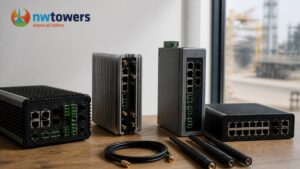
For hardware that operates across these bands, see our industrial wireless products built for harsh environments.
Integration is where most private 5G projects stall. A private wireless network has to talk to IT systems, operational technology, and legacy equipment that was never designed for modern networking.
IT and OT integration raises a governance question as much as a technical one: who owns the network, and who approves changes? Legacy systems often speak older protocols, so gateways and middleware bridge the gap. Network integration should be mapped during design, not discovered during installation.
Private 5G security best practices start with treating the network as critical infrastructure, not an extension of the office Wi-Fi. Data protection, device authentication, and segmentation all matter because industrial networks connect to physical operations.
A risk-based approach works best: identify what a breach would actually disrupt, then apply controls proportionally. Network security should cover device onboarding, traffic monitoring, and clear rules for third-party access. Northwest Towers builds monitoring into its managed services so anomalies surface before they become outages.
Private 5G and Wi-Fi comparison comes down to mobility, reliability, and control. Wi-Fi wins on cost and simplicity for fixed, low-mobility environments. Private 5G wins where devices move, where latency must stay predictable, and where coverage spans large outdoor areas.
| Factor | Private 5G | Wi-Fi |
|---|---|---|
| Mobility | Strong across large sites | Limited handoff at speed |
| Latency | Consistent and predictable | Variable under load |
| Coverage | Wide outdoor range | Shorter, obstruction-sensitive |
| Setup complexity | Higher, needs spectrum | Lower, familiar tooling |
| Best for | Mines, ports, mobile fleets | Offices, fixed sensors |
Many operations run both. The question isn’t which replaces the other, it’s which carries the traffic that can’t afford to drop.
Deployment cost splits into capital expenditure and operational expenditure, and the second one surprises teams. Hardware is a one-time line item. Day-2 operations, monitoring, and Day-3 optimization run for the life of the network. Most practitioners find that operational costs over a five-year horizon can equal or exceed initial capital outlay, yet many project budgets stop at installation.
Capital costs include radios, antennas, cabling, mounting hardware, spectrum access fees (where applicable), and integration labor. Operational costs include network monitoring, incident response, software updates, security patching, and the staffing to own all of it. A common pattern is to underestimate the staffing line item by treating the network as a set-and-forget utility rather than a managed service.
A skills shortage makes this harder. Few internal IT teams carry deep 5G expertise, so managed services and network-as-a-service (NaaS) models reduce the staffing burden. The trade-off is control: managed models shift operational responsibility to a provider but may limit customization and require clear service-level agreements. Return on investment and payback period depend on how much downtime and manual monitoring the network removes.
Day-2 operations are where pilots fail. A network that works on Day 1 can degrade on Day 30 as interference patterns shift, devices multiply, and software drifts. Day-2 covers monitoring, alerting, and incident response. Day-3 covers optimization: tuning radio parameters, adding capacity, and retiring obsolete hardware. Teams that plan only for Day 1 often discover on Day 30 that no one owns the network.
A practical Day-2 readiness checklist:
Northwest Towers builds monitoring into its managed services so anomalies surface before they become outages, and our industrial wireless products are designed for the environmental and operational realities of Day-2 and beyond.
A phased rollout beats a big-bang launch every time. Here’s the sequence we use:
For the hardware and engineering side, see our industrial wireless products built for exactly these environments.
Private 5G implementation fails on planning, integration, and operations far more often than on the radio itself. The teams that treat deployment as a phased program, not a hardware purchase, are the ones that hit their KPIs. Northwest Towers designs rugged antennas and networking equipment for harsh industrial sites and backs them with network engineering, deployment, and managed NaaS, so you get purpose-built hardware and the expertise to run it. Contact us to scope your deployment and get connectivity that holds up on Day 1 and Day 300.
The biggest challenges are spectrum acquisition and licensing complexity, network planning in RF-hostile industrial environments, integration with existing IT and OT systems, security architecture design, and the skills shortage for 5G expertise. Cost justification and Day-2 operations planning also trip up many deployments. A phased approach that starts with a pilot deployment and measurable KPIs helps teams address these challenges systematically rather than trying to solve everything at once.
The amount depends on your use case. Most industrial private 5G deployments use shared spectrum or licensed bands, with the specific bandwidth determined by device density, throughput requirements, and latency targets. A factory floor with hundreds of connected sensors needs different spectrum than a port running autonomous vehicles. Work with a network architect during the planning phase to model your actual traffic profile before committing to a spectrum strategy.
Integration typically happens at the edge, where private 5G connects to existing IT and OT networks through gateways and routers. Legacy systems that use older protocols may need protocol translation or industrial IoT gateways. The key is planning your integration architecture before deployment, not after. Most facilities run private 5G alongside existing Wi-Fi and wired networks during a transition period, migrating workloads gradually based on performance requirements.
Private 5G security best practices include network segmentation between IT and OT traffic, identity-based access controls for devices and users, encryption of data in transit, and continuous monitoring for anomalies. The biggest risk is treating private 5G as inherently secure because it is private. It still needs a risk-based security architecture, regular audits, and incident response planning. Device authentication and SIM management are also critical, especially when devices move across sites.