
Last Updated: October 5, 2026
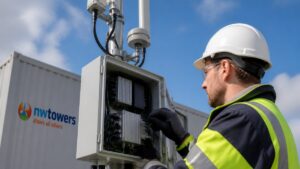
Technology towers is the collective term for the deployable connectivity and surveillance platforms that industrial sites use to move data across places where no permanent network reaches. That includes solar-powered trailers with retractable masts, mobile surveillance trailers, and the rugged networking equipment that ties them together.
The definition matters because the phrase gets applied to three very different things. Airport traffic control towers, cell towers, and cooling towers all show up in the same search results, and none of them describe what an operations director actually needs on a remote site.
That distinction is the throughline here. The tower is not the point. Uptime is the point, and uptime on a site that moves every few months looks nothing like uptime on a fixed campus.
A solar trailer pairs photovoltaic panels, a battery bank, and a retractable mast on a towable chassis. The panels charge the batteries during daylight, the batteries run the radios and cameras overnight, and the mast lifts the antennas above the clutter of containers, berms, and heavy equipment that would otherwise block the signal.
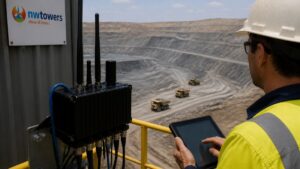
The mast is the part people underestimate. Ground-level antennas on a working site fight constant obstruction from haul trucks, stockpiles, and steel structures. Raising the antenna even a modest distance changes the geometry of the whole link, because industrial sites are rarely flat and rarely clear.
Deployment follows a predictable sequence:
Mast height, battery capacity, and radio choice set the coverage radius together, and treating them as independent variables is where most site plans go wrong. A taller mast buys line of sight. A larger battery buys hours of operation through cloudy stretches. Neither helps if the radio and antenna pattern do not match the terrain.
Work through the three in order. First, decide what has to be covered and at what bandwidth. Second, work out how much obstruction sits between the mast and the endpoints. Third, size the power system against the worst expected stretch of low solar input, not the average day.
Temporary network infrastructure wins on any site whose coverage requirements change faster than a permanent build can be justified. Permanent towers mean permitting, foundation work, trenching, and a fixed coverage footprint you are stuck with for years. When the pit advances or the construction phase shifts, that footprint is in the wrong place.
The economics follow the same logic. A permanent installation spreads its cost across a long service life. Put that same installation on a site with an 18-month horizon and you are paying for decades of structure to serve a fraction of it. A trailer-based platform moves with the work and gets redeployed elsewhere when the job ends.
Most teams compare a permanent tower against a trailer on hardware alone. The real difference sits in the costs that never show up on the equipment quote:
Versatility is not a marketing word here. It is a measurable property: how many distinct coverage problems can one platform solve over its service life? A towable mast platform can be redeployed from a pit rim to a laydown yard to a temporary stockpile in a single quarter. A fixed tower is locked to one geometry from the day the concrete cures.
Industrial networks change for reasons that have nothing to do with expansion: a new processing area, a temporary stockpile, a phase of construction that needs coverage for six weeks and then never again. Fixed infrastructure cannot follow that. Trailers can.
Temporary infrastructure is not the right answer everywhere. Permanent builds still make sense when:
The honest selection rule is this: if your coverage map looks different in eighteen months than it does today, permanent infrastructure is the wrong tool. Mobility is a requirement, not a convenience.
Northwest Towers designs and manufactures the deployable platforms that make this model work, including solar-powered trailers with retractable masts built for exactly this kind of redeployment.
Mobile surveillance trailers carry IP cameras on the same retractable mast platform, which makes them a natural extension of the network rather than a separate purchase.
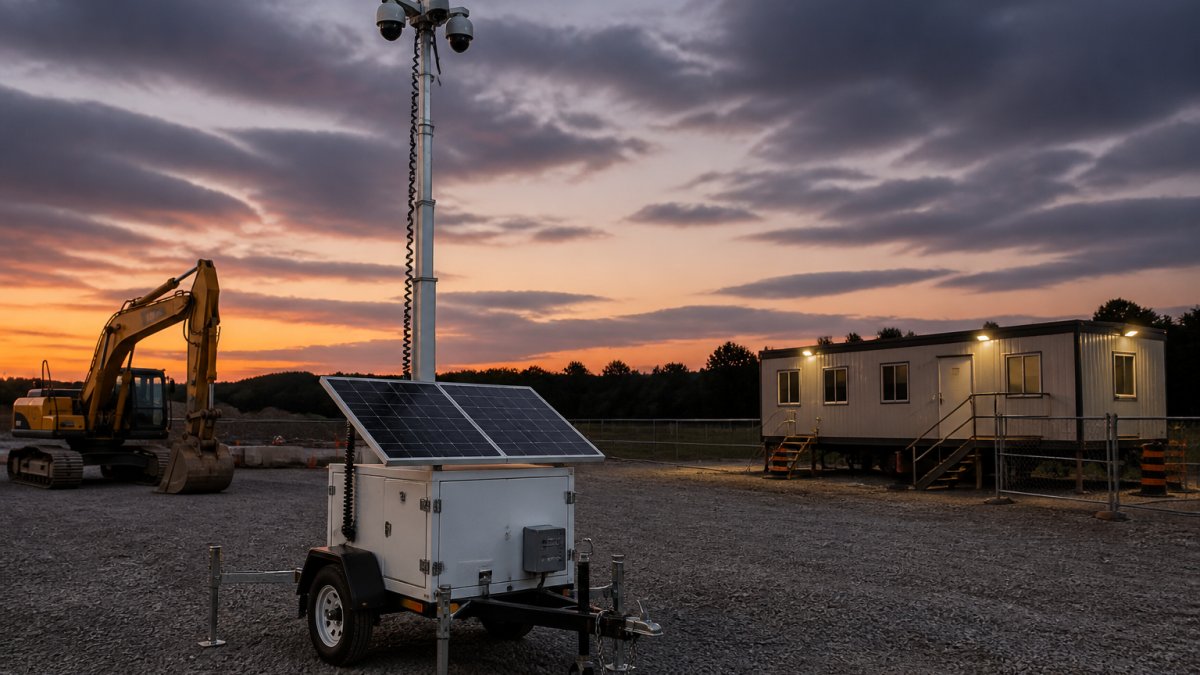
Two jobs drive most deployments. The first is theft prevention.
The second is safety compliance monitoring. Documenting that a site met its safety obligations is easier when the record exists automatically. Cameras covering access points, exclusion zones, and high-traffic areas produce that record without adding headcount.
The practical constraint is backhaul. Cameras generate far more traffic than sensors, so the link has to be sized for video, not for telemetry. Plan the network for the camera load first, then add everything else.
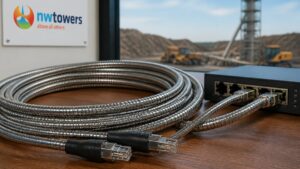
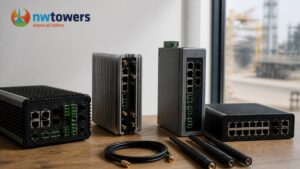
Rugged networking equipment is the difference between a platform that survives a season and one that survives a week. Industrial sites punish hardware in ways office-grade gear was never designed for: abrasive dust, constant low-frequency vibration from heavy equipment, temperature swings, and driving rain.
The IP rating on a piece of hardware is two digits, and both matter. The first digit covers solids, dust, grit, and the fines that coat a trailer mast after a week on a pit floor. The second covers water.
Temperature range is the other half of the environmental spec. A trailer in direct summer sun can run well above ambient inside its enclosure, so a radio rated to 140°F ambient may still be operating outside its comfort zone. Look for wide operating ranges and, where the hardware supports it, thermal management rather than assuming shade will save you.
Low-frequency vibration from haul trucks, excavators, and compactors is the failure mode that catches teams off guard. It does not usually break a radio outright, it works connectors loose, fatigues solder joints, and slowly degrades antenna mounts. The countermeasures are mechanical, not electronic:
When you specify hardware for a trailer deployment, ask the vendor which standards the equipment is tested to. Common references in this space include:
A vendor that can name the standards it tested to is a vendor that designed for the environment rather than one that relabeled an office product.
The maintenance angle matters as much as the specification. A platform that needs a technician on site every time something drifts is a platform that will be offline often, because the site is remote and the technician is not. Remote monitoring and proactive fault detection are what keep a distributed deployment manageable without a dedicated network team at every location.
Northwest Towers builds its portfolio around exactly this constraint, with IP-rated hardware and fully managed Network as a Service options that reduce or eliminate the capital outlay for teams that would rather buy connectivity as an operating cost. You can see the full hardware lineup on our rugged industrial wireless products page.
Mining, ports, and construction need different things from the same platform category, and matching the configuration to the environment is what separates a working deployment from an expensive one.
| Environment | Primary Need | Platform Priority | Watch For |
|---|---|---|---|
| Open-pit mining | Coverage that follows the pit | High mast, long-range backhaul | Advancing faces leaving coverage behind |
| Underground mining | Connectivity in confined workings | Leaky feeder or node-based coverage | Signal loss around corners and bends |
| Ports | Asset tracking across a wide terminal | Multiple linked masts, high reliability | Steel containers and cranes blocking line of sight |
| Construction | Fast setup, frequent relocation | Towable, quick-deploy trailers | Site layout changing every phase |
| Utilities and renewables | Remote monitoring backhaul | Solar autonomy, low maintenance | Long service intervals between site visits |
The pattern across all five is that coverage requirements move. A pit deepens and widens. A terminal adds a berth. A construction site enters a new phase. Utilities add remote assets faster than they add staff.
That is the argument for treating technology towers as a deployable capability rather than a construction project.
Coverage requirements on industrial sites change faster than permanent infrastructure can adapt, and every month spent waiting on a fixed build is a month of workarounds.
A solar-powered trailer generates its own power from a panel array and battery bank, so it needs no grid connection or diesel generator. That matters on a site where power is not yet run. The retractable mast lifts an access point or antenna several meters above ground, clearing containers, equipment, and terrain that block signal. Crews get coverage on day one, and the unit moves to the next phase of the job when the work moves.
Height is the main one. Raising an antenna above ground clutter extends signal range and reduces dead zones around processing plants and pit walls. A retractable mast also travels legally on a standard trailer, deploys in under an hour, and lowers again for relocation. For networks that change as a project progresses, that flexibility avoids the months of permitting and construction a fixed tower requires.
Yes. Mobile surveillance trailers carry IP cameras alongside the network gear, so video runs over the same wireless link that serves operations. That covers anti-theft monitoring of fuel, copper, and tools, plus safety compliance checks at gatehouses and active work zones. Because the trailer moves, cameras follow the work rather than sitting on a fixed pole watching an empty area.
Permanent towers make sense when coverage needs stay put for a decade. Most industrial projects do not. Pits deepen, phases shift, and laydown yards relocate every few months. A fixed tower built for one layout becomes the wrong tower once the layout changes. Temporary network infrastructure can be repositioned in a day, which keeps coverage aligned with where crews and equipment actually are.