
Last Updated: September 28, 2026
The 5 best private 5G use cases for mining are autonomous equipment connectivity, real-time telemetry and predictive maintenance, worker safety monitoring, remote teleoperation, and high-bandwidth video and AR support. Each depends on a network that holds up underground, in extreme weather, and around heavy electrical equipment.
Autonomous haulage systems (AHS) are the clearest private 5G use case in mining because they fail without deterministic, low-latency links. A driverless haul truck continuously exchanges position, speed, and obstacle data with a control system, and that exchange cannot stall.
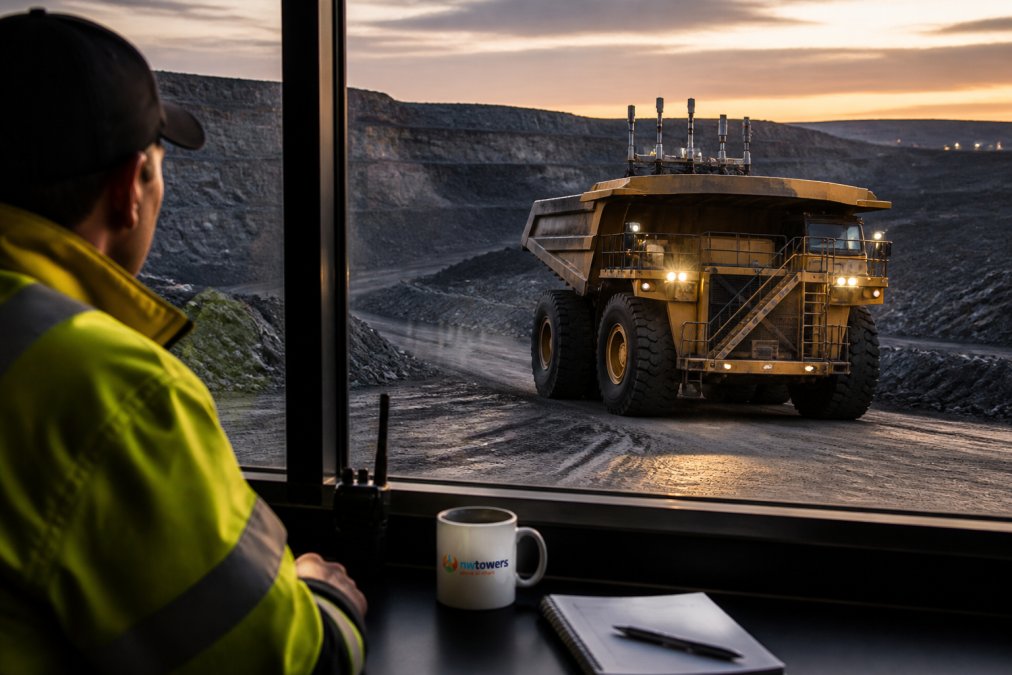
An autonomous truck that receives a stop command half a second late has already traveled several meters. Private 5G’s ultra-reliable low-latency communication (URLLC) profile keeps command-to-action cycles tight and predictable, while Wi-Fi’s good average latency hides the spikes that matter.
Real-time telemetry turns maintenance from a schedule into a signal. Vibration, temperature, hydraulic pressure, motor current, and oil-particle data stream off equipment continuously, and private 5G carries that volume without the contention that clogs shared Wi-Fi. A useful predictive maintenance program comes down to three decisions: what you sample, where you analyze it, and how the result reaches a technician.
The sensors that pay for themselves fastest on mining equipment are usually the ones watching rotating and hydraulic components:
Sending every sensor reading to a distant cloud adds latency and depends on backhaul remote sites rarely have. Edge computing keeps the first pass of analysis on site: a private 5G network with edge nodes can flag an abnormal vibration signature in seconds, then forward only meaningful events upstream.
A practical split that most operations settle into:
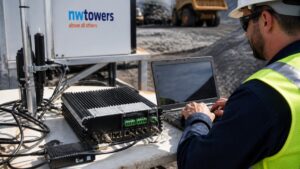
For the radio and antenna side of that telemetry build, rugged industrial wireless hardware | /products rated for vibration, dust, and wide temperature swings is what keeps the sensor data flowing when the equipment is working hardest.
Worker safety monitoring is where private 5G earns its place fastest, because the payoff is measured in injuries avoided. Connected wearables track location, detect falls or prolonged immobility, and trigger alerts when someone enters an equipment operating zone.
The same network supports proximity detection between light vehicles and heavy equipment, one of the most persistent hazards on any site. Vehicles exchange position data over the network rather than relying on line-of-sight sensors alone, which matters because a haul truck’s blind spots are large and its stopping distance is measured in tens of meters.
Underground, the safety case shifts from traffic to atmosphere. Fixed and wearable gas sensors monitor for carbon monoxide, methane, hydrogen sulfide, and oxygen deficiency. Historically these reported over leaky feeder or cabled networks with limited coverage; private 5G can carry the same data from portable and fixed units, so a worker’s personal gas monitor can trigger an alert reaching both the worker and the surface control room in the same second.
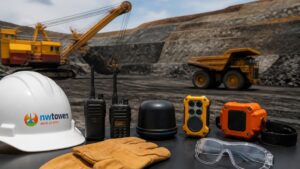
For sites building this layer, rugged industrial wireless hardware | /products designed for underground and wash-down environments is the foundation that keeps safety telemetry online when conditions are worst.
Teleoperation lets a skilled operator run equipment from a remote operations center instead of the cab. Private 5G makes it practical by carrying the control link and video feed on one network with consistent latency.
Private 5G wins for mobile, mission-critical, and wide-area coverage. Wi-Fi still wins on cost for fixed, high-density indoor spaces like offices and workshops. Most mines end up running both, each doing what it does best.
| Factor | Private 5G | Wi-Fi |
|---|---|---|
| Mobility handoff | Designed for fast movement, seamless | Handoffs drop links at speed |
| Coverage per radio | Kilometres in open pit | Hundreds of metres, line-of-sight |
| Latency consistency | Low jitter, sliceable | Variable under load |
| Interference | Licensed or shared spectrum, managed | Unlicensed bands, congested |
| Best fit | Mobile equipment, teleoperation, safety | Offices, workshops, fixed sensors |
Wi-Fi’s weakness in mining is not peak speed. It is behavior under mobility and interference. A truck moving at speed crosses access points faster than Wi-Fi handoffs handle cleanly, and unlicensed spectrum at a busy site gets crowded. Private 5G uses managed spectrum, which is why the FCC’s Citizens Broadband Radio Service framework matters to mining operators planning their own networks.
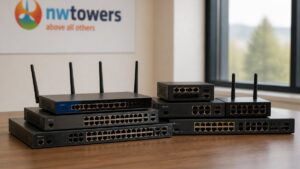
Rugged industrial wireless hardware decides whether a private 5G design survives contact with a real mine. The radio plan can be perfect on paper and still fail if the enclosure cannot take the environment.
What actually matters when specifying equipment:
NIST’s cybersecurity framework for critical infrastructure is a reasonable starting point for structuring the security phase, adapted to your OT environment.
Private 5G enables real-time video surveillance, wearable sensors, and vehicle-to-vehicle communication to prevent accidents. It supports low-latency alerts for proximity detection and fatigue monitoring, and provides reliable coverage in remote areas where Wi-Fi fails. This helps meet MSHA safety requirements and reduces incident response times.
Private 5G offers greater range, lower latency, and higher reliability than Wi-Fi. It handles high-speed mobility for autonomous vehicles and supports thousands of IoT devices without interference. In mining, 5G’s deterministic performance ensures mission-critical tasks like remote control and safety monitoring work consistently, even in harsh underground environments.
Private 5G provides ultra-reliable low-latency communication (URLLC) for autonomous haulage systems (AHS). It enables real-time telemetry, remote teleoperation, and precise coordination between vehicles. This reduces downtime and improves operational efficiency by allowing continuous data exchange between equipment and the remote operations center.
You need ruggedized 5G antennas, base stations, edge computing nodes, and a core network. Spectrum access (such as CBRS) and integration with legacy systems are also key. Northwest Towers provides industrial wireless hardware and Network as a Service to simplify deployment, with site surveys and ongoing monitoring to ensure coverage in extreme conditions.
Private 5G delivers high throughput and low latency, allowing real-time telemetry from sensors and vehicles to be processed at the edge. This enables predictive analytics for maintenance and operational insights without sending data to the cloud. Edge computing reduces bandwidth costs and ensures quick decisions in remote areas.