
Last Updated: September 21, 2026
Industrial network security protects systems where a breach can stop physical production, while enterprise security protects data and transactions where a breach risks financial and privacy loss. That distinction drives nearly every difference between the two disciplines. At Northwest Towers, we design rugged wireless equipment for mining, ports, construction, and utility sites, and we see these trade-offs play out weekly.
Availability outranks confidentiality on the plant floor. An enterprise team will take a server offline to patch a critical flaw; an operations team running a continuous process cannot accept that downtime without losing product, revenue, and sometimes safety margins. Industrial control systems often run on decade-old hardware with limited memory and no modern encryption support, and forcing enterprise-grade authentication onto them can introduce latency that disrupts real-time control loops. Segment security instead: keep OT traffic isolated, apply controls that fit the device, and reserve strict privacy policies for IT.
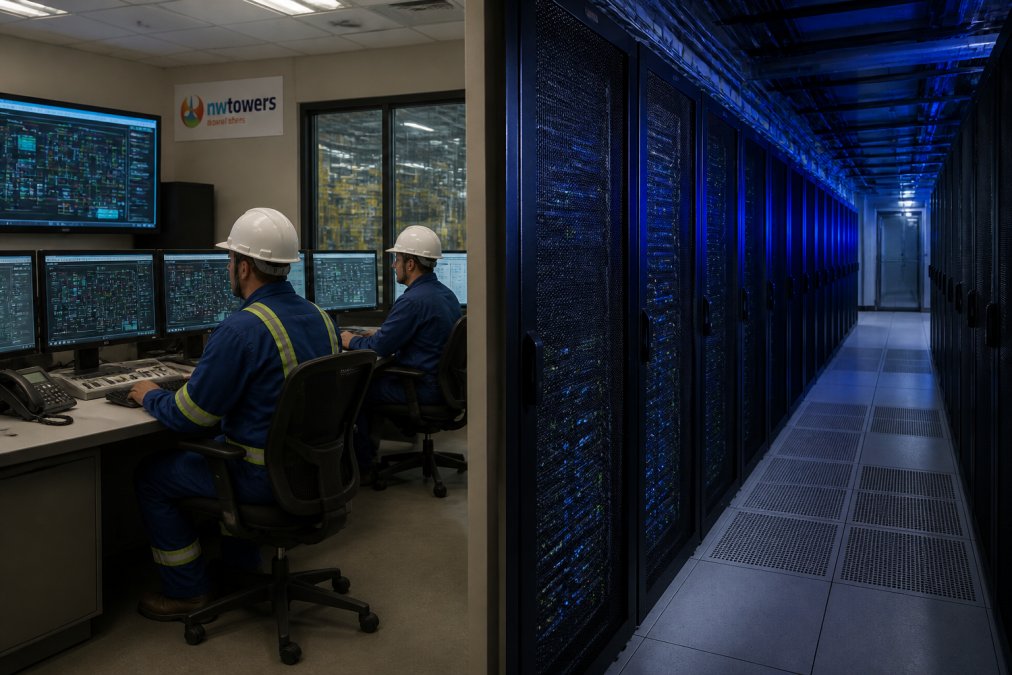
IT and OT security convergence unifies information technology and operational technology security under shared policies, monitoring, and governance while respecting each environment’s constraints. It is happening whether teams plan for it or not, because Industry 4.0 keeps connecting plant-floor devices to enterprise analytics. The common mistake is treating convergence as a tooling problem; it is a governance problem: who owns the firewall between the corporate VLAN and the control network, who approves firmware updates, and who gets paged at 2 a.m. when a PLC drops offline. Answer those questions before buying a license.
Industrial network security rests on segmentation, controlled access, and continuous monitoring built for devices that cannot tolerate downtime. Enterprise stacks assume modern operating systems and frequent patching; industrial environments assume neither. Network segmentation and zero trust architecture come first, limiting lateral movement if a device is compromised. Firewalls, access control lists, and intrusion detection systems come next, tuned to industrial protocols rather than HTTP. Endpoint protection still applies, but on hardened industrial PCs and gateways.
Zero trust architecture treats every device and user as untrusted until verified, and it fits industrial networks because flat OT networks are a liability. The Purdue model still provides a useful zoning reference: separate field devices, the control layer, and the enterprise layer with enforced boundaries. Air-gapped networks were once the default, but most modern plants have at least one bridge to IT for reporting or remote support, and that bridge is where segmentation earns its keep. A common mistake is leaving a maintenance laptop or vendor VPN as an unmonitored path across zones.
Industrial firewalls must understand protocols like Modbus, DNP3, and EtherNet/IP, not just TCP/IP. A standard enterprise firewall will block or misread legitimate control traffic, which is why protocol-tuned packet inspection matters. Access control lists should follow least privilege: a historian server reads from PLCs, it does not write to them. Intrusion detection on OT networks focuses on anomaly detection rather than signatures, because attacks against industrial control systems often look like unusual but valid commands. Real-time monitoring and traffic analysis share one goal: catch the deviation before it becomes a shutdown.
Most industrial protocols were designed for deterministic delivery on isolated serial links, not for a world where a maintenance laptop, vendor VPN, or cellular gateway can reach a PLC. That legacy is the core vulnerability, and it is where industrial network security diverges most sharply from enterprise security. Enterprise stacks assume TCP/IP with mature extensions, TLS, IPsec, 802.1X, certificate-based authentication. Industrial protocols assume none of that.
Take Modbus TCP: no authentication field, no session concept, no integrity check. Any host that can reach TCP port 502 can write to a coil or register, and the PLC will execute it. DNP3 adds a link-layer frame check but leaves out-of-the-box authentication and encryption; DNP3-SA exists but is rarely enabled on legacy outstations. EtherNet/IP rides on CIP, which supports CIP Security in newer revisions, yet most deployed devices predate it. PROFINET relies on the underlying Ethernet fabric with little application-layer protection.
A practical hardening sequence that works on legacy protocols:
CISA guidance on securing industrial control systems
NIST SP 800-82 Guide to Operational Technology Security
Industrial cybersecurity best practices prioritize risk mitigation that does not interrupt production, which rules out a lot of standard IT advice. You cannot scan the entire OT network during peak hours, because active scanning can crash fragile devices, and you cannot enforce weekly reboots on a controller running a continuous process. What works is a layered approach: harden what you can, isolate what you cannot, and monitor everything.
SCADA, PLC, and industrial control system security depends on controlling who can reach the device and what commands they can send. Start with the network path: if a PLC does not need to talk to the internet, it should not have a route there. Then control identity: unique accounts per engineer, no shared logins, and multi-factor authentication on any remote access gateway.
Incident response in industrial environments inverts the enterprise playbook, it changes who is in the room, what the first move is, and what “recovered” means.
Managed network services for industrial sites cover the design, deployment, monitoring, and support of the network so operations teams do not have to staff a dedicated OT security group. A fair question from operations directors: if we hand over monitoring, do we lose the ability to run our own network? A managed model should give you visibility, not dependency, you keep the architecture and credentials, and the provider handles 24/7 monitoring, anomaly detection, and hardware support your team lacks bandwidth for.
CISA guidance on securing industrial control systems
NIST SP 800-82 Guide to Operational Technology Security
IT security prioritizes data confidentiality and privacy, while OT security focuses on system availability and safety. In enterprise environments, a breach might expose customer data. In industrial settings, a security failure could halt production, damage equipment, or endanger workers. OT networks often run legacy protocols like Modbus or DNP3 that lack built-in encryption, requiring different protection strategies than standard IT systems.
Enterprise tools assume regular patching cycles and tolerate brief downtime for updates. Industrial networks often run 24/7 and cannot restart PLCs or SCADA systems without stopping operations. Many industrial protocols predate modern security standards, and endpoint agents may interfere with real-time control traffic. Industrial network security requires tools designed for deterministic performance, legacy protocol support, and rugged hardware that survives extreme temperatures, vibration, and dust.
Convergence connects previously isolated OT networks to enterprise IT systems for data analytics and remote monitoring. This creates new threat vectors: attackers can pivot from a compromised email account to production systems. Best practices include network segmentation between IT and OT zones, zero trust architecture at boundary points, continuous monitoring for lateral movement, and unified incident response plans that address both environments without sacrificing uptime.
Managed network services for industrial sites provide continuous monitoring, threat detection, and rapid response without requiring on-site IT staff. Providers handle firewall policy updates, vulnerability assessments, and anomaly detection across remote locations. This model suits operations with limited security expertise or multiple distributed sites, as it delivers consistent protection and reduces the burden on stretched internal teams while maintaining the availability industrial operations demand.